AI-conciërge voor hotels: wat het is, hoe het werkt en waarom het er in 2026 toe doet
In 2026 is een AI-conciërge voor hotels geen luxe meer maar een noodzaak, die naadloos gastinteracties afhandelt via chat, spraak en messaging met real-time gegevens uit property management systemen. De intelligente oplossingen van Vertize, zoals Lynn, stellen hotels in staat om te voldoen aan stijgende gastverwachtingen en routinevragen om te zetten in gepersonaliseerde ervaringen die tevredenheid en omzet stimuleren.
AI-conciërge voor hotels: wat het is, hoe het werkt en waarom het er in 2026 toe doet
Een AI-conciërge voor hotels is een intelligent gastgericht systeem dat gesprekken afhandelt, vragen beantwoordt, aanbevelingen doet en taken uitvoert via chat-, spraak- en messagingkanalen, terwijl het real-time gegevens ophaalt uit het property management system van het hotel. In tegenstelling tot basischatbots die rigide scripts volgen, begrijpt een AI-conciërge de context, onthoudt gastvoorkeuren, communiceert in tientallen talen en werkt dag en nacht. Voor hotels die te maken hebben met personeelstekorten en stijgende gastverwachtingen, wordt deze technologie snel het verschil tussen een vergeetbaar verblijf en een opmerkelijk verblijf.
Als u in 2026 een hotel runt, heeft u waarschijnlijk de term "AI-conciërge" gehoord op vakbeurzen, in leverancierspresentaties en in branchepublicaties. Maar de definities variëren enorm. Sommige leveranciers hernoemen een basis-FAQ-chatbot als een AI-conciërge. Anderen gebruiken het om een spraakassistent te beschrijven die telefoongesprekken beantwoordt. Een paar gebruiken het als een verzamelnaam voor elk AI-hulpmiddel dat gastcommunicatie raakt.
Deze gids snijdt door de ruis heen. Het behandelt precies wat een AI-conciërge is, hoe de technologie onder de motorkap werkt, waar het verschilt van traditionele chatbots, wat voor soort resultaten hotels zien en waar u op moet letten bij het evalueren van oplossingen. Of u nu een boutique-eigendom beheert of een multi-site portfolio, dit is de basis die u nodig hebt voordat u een AI-investeringsbeslissing neemt.
Wat is een AI-conciërge voor hotels?
Een AI-conciërge is een gastgerichte intelligentielaag die natuurlijke taalverwerking en grote taalmodellen gebruikt om echte gesprekken te voeren met hotelgasten via meerdere kanalen. Het verbindt met het property management system (PMS) van het hotel en andere operationele tools om real-time toegang te krijgen tot reserveringsgegevens, kamerdetails, lokale aanbevelingen en servicebeschikbaarheid.
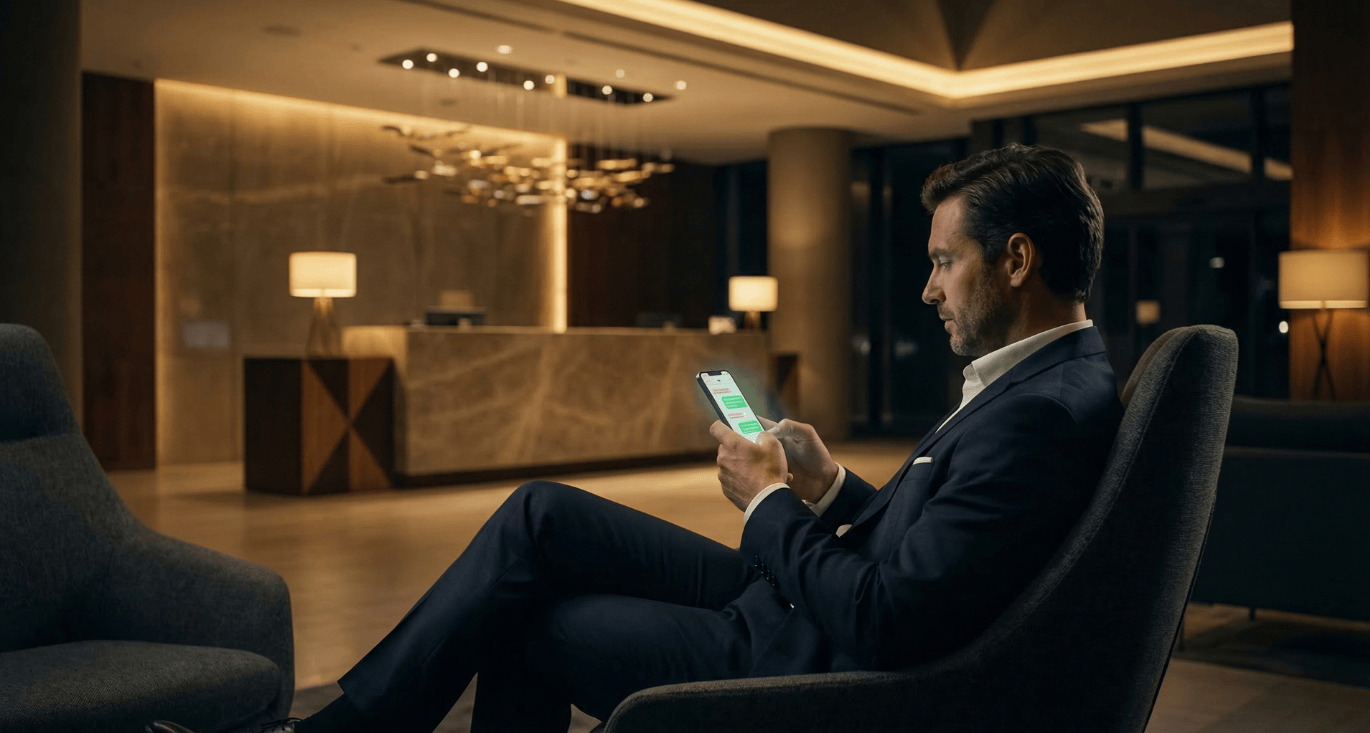
Denk eraan als het digitale equivalent van een deskundige, meertalige conciërge die altijd beschikbaar is en nooit een slechte dag heeft. Maar in plaats van achter een lobbybalie te zitten, leeft het op WhatsApp, uw hotelwebsite, de telefoon van de gast en steeds meer op spraakkanalen waar het binnenkomende oproepen beantwoordt.
Het belangrijkste onderscheid is intelligentie. Een traditionele chatbot volgt een beslisboom: als een gast "zwembaduren" typt, retourneert het een vooraf geschreven antwoord. Een AI-conciërge begrijpt de intentie achter een vraag, zelfs als deze op onverwachte manieren wordt geformuleerd. Een gast die "kunnen mijn kinderen na het eten zwemmen?" bericht, krijgt een antwoord dat rekening houdt met sluitingstijden van het zwembad, het kinderzwembadbeleid en het dinerschema, allemaal opgehaald uit de eigen gegevens van het hotel.
Dit is belangrijk omdat gastverwachtingen dramatisch zijn verschoven. Volgens het Hotel Guest Tech Report 2025 gelooft 58% van de hotelgasten dat AI hun verblijf kan verbeteren, en 70% vindt AI-gestuurde tools nuttig voor eenvoudige verzoeken zoals het controleren van Wi-Fi-wachtwoorden of het bestellen van roomservice. De vraag is er. De vraag voor hoteliers is of ze eraan voldoen met een basis gescript hulpmiddel of een intelligent systeem dat de gast daadwerkelijk begrijpt en bedient.
Grote hotelmerken bewegen snel. Hilton lanceerde zijn AI Planner in maart 2026, een generatieve AI-conciërge die gasten helpt eigendommen te verkennen en verblijven te plannen via conversationele taal. IHG werkte samen met Google Cloud voor zijn AI-reisplanner. Renaissance Hotels van Marriott rolden AI-tools uit op hun websites. Deze stappen signaleren dat AI-gestuurde gastinteractie niet langer experimenteel is. Het wordt de verwachte standaard.
Voor onafhankelijke hotels en kleinere groepen creëert dit zowel een uitdaging als een kans. U hoeft geen AI-conciërge vanaf nul te bouwen. Toegewijde oplossingen zoals Lynn van Vertize verbinden met uw bestaande PMS en gaan live via gastgerichte kanalen zonder dat een technologieteam hoeft te bouwen of onderhouden.
Hoe werkt een AI-conciërge eigenlijk?
Een AI-conciërge werkt door een groot taalmodel (de "hersenen" die natuurlijke taal begrijpen en genereren) te combineren met een real-time integratielaag die verbindt met de operationele systemen van het hotel. Wanneer een gast een bericht verzendt of een oproep plaatst, verwerkt het systeem het verzoek in milliseconden door verschillende stappen.
Hier is hoe de stroom in de praktijk werkt:
Stap 1: De gast neemt contact op. Dit kan gebeuren op elk kanaal dat het hotel ondersteunt. WhatsApp, webchat, SMS, e-mail, Facebook Messenger of een telefoongesprek. De AI-conciërge ontvangt het binnenkomende bericht of transcribeert de spraakinvoer.
Stap 2: Het systeem begrijpt de intentie. Met behulp van natuurlijke taalverwerking identificeert de AI wat de gast eigenlijk vraagt. "Is de gym vroeg open?" en "kan ik voor het ontbijt trainen?" triggeren dezelfde respons, ook al is de formulering compleet anders. Het systeem detecteert ook de taal van de gast en reageert dienovereenkomstig, zonder dat de gast een taalvoorkeur hoeft te selecteren.
Stap 3: Het haalt live gegevens op uit het PMS en andere systemen. Dit is wat een AI-conciërge scheidt van een generieke chatbot. Het systeem bevraagt het property management system voor de reserveringsdetails van de gast, kamertype, incheckdatum en speciale verzoeken. Het kan ook gegevens ophalen uit de channel manager, het reserveringssysteem van het restaurant, spa-software of lokale activiteitendatabases.
Stap 4: Het genereert een contextuele respons. In plaats van een ingeblikt antwoord te retourneren, stelt de AI een respons samen die rekening houdt met de specifieke gast, hun verblijfsdetails en de huidige operationele realiteit. Een gast die morgen incheckt, krijgt andere informatie dan een die vandaag uitcheckt.
Stap 5: Het onderneemt actie waar passend. Geavanceerde AI-conciërges beantwoorden niet alleen vragen. Ze kunnen roomservicebestellingen verwerken, spa-afspraken boeken, late check-outs aanvragen, onderhoudsproblemen voor personeel markeren en upsell-aanbiedingen pushen op het juiste moment in de gastreis. Elke actie synchroniseert terug naar de systemen van het hotel.
Stap 6: Het leert en verbetert. Elke interactie traint het systeem. Wanneer een gast een vraag stelt die de AI niet kan afhandelen en een medewerker inspringt, wordt die oplossing trainingsdata. Na verloop van tijd handelt de AI een groter deel van de interacties zelfstandig af, terwijl personeel zich richt op complexe, hoogwaardige gastmomenten.
De onderliggende technologie heeft zich snel ontwikkeld. In 2026 gebruiken de meest effectieve AI-conciërgesystemen retrieval-augmented generation (RAG), een techniek die de antwoorden van de AI baseert op de daadwerkelijke gegevens van het hotel in plaats van het taalmodel mogelijk onnauwkeurige informatie te laten genereren. Dit is cruciaal in de hospitality, waar een verkeerd antwoord over een allergiemenu of een sluitingstijd van het zwembad niet alleen onbehulpzaam maar potentieel schadelijk is.
Wat is het verschil tussen een AI-conciërge en een hotelchatbot?
Een AI-conciërge en een traditionele hotelchatbot lossen hetzelfde oppervlakkige probleem op (gastvragen beantwoorden), maar ze verschillen fundamenteel in hoe ze taal begrijpen, toegang krijgen tot gegevens en complexe verzoeken afhandelen. Het onderscheid is belangrijk omdat het kiezen van het verkeerde hulpmiddel leidt tot gefrustreerde gasten en verspilde investeringen.
Hier is hoe de twee zich verhouden op de capaciteiten die het meest van belang zijn voor hoteloperaties:
Mogelijkheid | Traditionele hotelchatbot | AI-conciërge |
|---|---|---|
Taalbegrip | Trefwoordmatching en beslisbomen | Natuurlijke taalverwerking met contextbewustzijn |
Responstype | Vooraf geschreven, statische antwoorden | Dynamisch gegenereerde, gepersonaliseerde antwoorden |
PMS-integratie | Beperkt of geen | Diepe, real-time tweerichtingsdata-uitwisseling |
Meertalige ondersteuning | Typisch 5 tot 10 talen via vertaling | 50+ talen met native vloeiendheid |
Kanaaldekking | Meestal alleen webchat | Chat, spraak, WhatsApp, SMS, e-mail, sociale media |
Gastpersonalisatie | Generiek (zelfde antwoord voor elke gast) | Contextbewust (past zich aan aan reservering, voorkeuren, geschiedenis) |
Taakuitvoering | Alleen vragen beantwoorden | Vragen beantwoorden, verzoeken verwerken, workflows activeren |
Leercapaciteit | Statisch (handmatige updates nodig) | Continu leren van elke interactie |
Overdracht aan personeel | Abrupt of niet-bestaand | Naadloos met volledige gesprekscontext behouden |
Upsell-mogelijkheid | Basis pop-ups of prompts | Contextbewuste, getimede aanbiedingen op basis van gastprofiel en reisstadium |
Een regelgebaseerde chatbot werkt prima voor de eenvoudigste laag gastvragen: "Hoe laat is het ontbijt?" of "Wat is het Wi-Fi-wachtwoord?" Maar zodra een gast iets vraagt buiten het script, valt de ervaring uiteen. "Kunt u een goed restaurant aanbevelen in de buurt van het hotel dat kindvriendelijk is en laat open is?" gaat verder dan wat een gescript systeem kan afhandelen.
Een AI-conciërge handelt deze genuanceerde verzoeken af omdat het intentie en context tegelijk begrijpt. Het weet dat de gast met kinderen reist (uit de reserveringsgegevens), dat het 21:00 uur is (tijdbewust) en dat "in de buurt van het hotel" binnen loopafstand betekent (locatiebewust). De respons voelt behulpzaam en persoonlijk in plaats van robotachtig en frustrerend.
Deze verschuiving van gescript naar intelligent is waarom brancheanalisten de categorieën steeds vaker scheiden. Het PhocusWire 2026 AI-trendsrapport merkte op dat hoteliers een breekpunt hebben bereikt met leveranciers die "AI-aangedreven" labels plakken op bestaande tools zonder betekenisvolle technische verandering. Het onderscheid tussen een echte AI-conciërge en een hernoemde chatbot is geen marketing-semantiek. Het is het verschil tussen een tool dat gasten daadwerkelijk gebruiken en een tool dat ze na één interactie verlaten.
Wat kan een AI-conciërge doen voor hotelgasten?
Een AI-conciërge ondersteunt gasten gedurende de hele verblijfsreis, vanaf het moment van boeken tot lang na uitchecken. De meest effectieve implementaties dekken pre-verblijf, tijdens-verblijf en post-verblijf touchpoints, waardoor een continue draad van gepersonaliseerde communicatie ontstaat.
Pre-aankomst
De gastrelatie begint voordat ze door de deur lopen. Een AI-conciërge kan dagen voor aankomst een gepersonaliseerd welkomstbericht verzenden via WhatsApp of SMS, reserveringsdetails bevestigen, vroege incheck of kamerupgrades aanbieden en vragen vooraf beantwoorden over parkeren, richtingen of lokaal vervoer. Dit is ook het venster met de hoogste conversie voor upselling. Gasten zijn enthousiast over hun komende reis en open voor add-ons zoals ontbijtpakketten, luchthaventransfers of spa-boekingen.
Hotels die AI-gedreven pre-aankomstberichten gebruiken, melden dat contextbewuste aanbiedingen significant beter converteren dan generieke blast-e-mails. Wanneer de AI weet dat een terugkerende gast de spa heeft geboekt tijdens het laatste bezoek, kan het proactief een spa-pakket aanbieden in plaats van een generieke kamerupgrade. Dat soort precisie is onmogelijk op schaal zonder automatisering.
Tijdens het verblijf
Dit is waar de AI-conciërge elk uur zijn waarde verdient. Veelvoorkomende interacties tijdens het verblijf zijn onder meer:
Vragen beantwoorden over hotelfaciliteiten, openingstijden en beleid
Roomservicebestellingen en speciale verzoeken verwerken
Restaurants, activiteiten en lokale ervaringen aanbevelen
Onderhouds- of huishoudelijke verzoeken afhandelen en doorsturen naar het juiste personeel
Late check-out verzoeken beheren
Real-time informatie verstrekken over evenementen, weer of vervoer
Communiceren in de moedertaal van de gast zonder dat personeel meertalig hoeft te zijn
De 24/7-beschikbaarheid is bijzonder impactvol. Hotels missen consequent oproepen en berichten tijdens piek-incheckvensters, vroege ochtenden en late avonden. Elke onbeantwoorde vraag is ofwel een gemiste inkomstenskans of een negatieve gastervaring. Een AI-conciërge elimineert die kloof volledig. Een gast kan om 5 uur 's ochtends vragen stellen over ontbijtopties of om middernacht extra handdoeken aanvragen en een onmiddellijk, accuraat antwoord krijgen.
Post-verblijf
Na uitchecken kan de AI-conciërge een gepersonaliseerd bedankbericht verzenden, feedback vragen en een directe boekingslink delen voor het volgende verblijf van de gast. Hotels die AI gebruiken voor post-verblijf follow-up zien meetbare verbeteringen in reviewgeneratie en herboekingspercentages. Gepersonaliseerde reisaanbiedingen aangedreven door AI zijn gekoppeld aan herboekingsstijgingen tot 25%, volgens analyses in de hospitality-industrie.
Welke resultaten zien hotels met AI-conciërges?
Hotels die AI-conciërges implementeren, melden meetbare verbeteringen op het gebied van omzet, operationele efficiëntie en gasttevredenheid. De resultaten zijn het sterkst wanneer de AI diep is geïntegreerd met het PMS en is uitgerold over meerdere gastgerichte kanalen.
Omzetimpact
Directe boekingen zijn de duidelijkste winst. Hotels die AI-gestuurde gastcommunicatieplatforms gebruiken, melden een gemiddelde stijging van 35% in directe boekingen, grotendeels gedreven door het vermogen van de AI om websitebezoekers in real time door het reserveringsproces te begeleiden. Diezelfde real-time begeleiding helpt de afhankelijkheid van OTA's te verminderen, wat de marges op elke boeking direct verbetert.
Upselling is de tweede omzethefboom. AI-conciërges die het profiel, de verblijfsdata en voorkeuren van een gast begrijpen, kunnen contextueel relevante upgrades en add-ons aanbieden op het juiste moment. Het verschil tussen een generieke pop-up en een gepersonaliseerd WhatsApp-bericht dat een late check-out aanbiedt omdat de AI weet dat uw vlucht om 21:00 uur vertrekt, is het verschil tussen een conversiepercentage van 2% en een significant hoger percentage.
Operationele efficiëntie
De vermindering van de werklast van personeel is onmiddellijk en significant. De meerderheid van de vragen die hotelserviceteams afhandelen, is routine: Wi-Fi-wachtwoorden, zwembaduren, uitchecktijden, restaurantreserveringen, parkeerinformatie. Volgens het Hotel Guest Tech Report 2025 vindt 70% van de gasten AI-tools nuttig voor precies dit soort eenvoudige verzoeken. Door dat volume om te leiden naar een AI-conciërge, winnen frontdesk- en conciërgepersoneel tijd terug voor de interacties die daadwerkelijk een menselijke touch vereisen.
Hotels die AI-conciërgeoplossingen hebben geïmplementeerd, melden dat het volume aan frontdeskvragen met tot 40% daalt en responstijden verbeteren van minuten (of uren, tijdens piekperiodes) naar seconden. Dit gaat niet over het vervangen van personeel. Het gaat erom hen te bevrijden van repetitieve taken zodat ze zich kunnen richten op de gastmomenten die loyaliteit opbouwen en reviews genereren.
Gasttevredenheid
Snellere responstijden en 24/7-beschikbaarheid correleren direct met hogere tevredenheidsscores. Wanneer gasten binnen seconden een accuraat antwoord krijgen in plaats van te wachten in een telefoonwachtrij of naar de receptie te lopen, verbetert hun perceptie van de servicekwaliteit, ook al hebben ze met een machine gecommuniceerd.
De nuance is belangrijk: gasten willen AI voor snelheid en gemak bij routineverzoeken, maar ze geven nog steeds de voorkeur aan menselijke interactie bij emotioneel complexe situaties. De beste AI-conciërge-implementaties herkennen deze grens en dragen naadloos over aan personeel wanneer het gesprek empathie, onderhandeling of creatieve probleemoplossing vereist.
Waarom is PMS-integratie belangrijk voor een AI-conciërge?
PMS-integratie is de belangrijkste technische factor die bepaalt of een AI-conciërge echte waarde levert of gewoon fungeert als een opgeblazen FAQ-pagina. Zonder live toegang tot het property management system werkt de AI in een vacuüm, niet in staat om antwoorden te personaliseren of zinvolle actie te ondernemen namens de gast.
Hier is wat PMS-integratie mogelijk maakt dat standalone AI-tools niet kunnen doen:
Gepersonaliseerde antwoorden op basis van reserveringsgegevens. Wanneer de AI weet dat een gast morgen incheckt voor een verblijf van drie nachten in een suite, kan het elke interactie dienovereenkomstig afstemmen. "Uw kamer is klaar vanaf 15:00 uur. Wilt u dat we een luchthaventransfer regelen?" is fundamenteel anders dan een generiek "Inchecken begint om 15:00 uur."
Real-time beschikbaarheid en prijzen. Een met PMS verbonden AI-conciërge kan "Heeft u een kamer beschikbaar voor vanavond?" beantwoorden met een accuraat ja-of-nee en een actueel tarief. Een losgekoppeld systeem kan alleen zeggen "Bel de receptie" of, erger nog, verouderde informatie verstrekken.
Tweerichtingsoperationele synchronisatie. Wanneer een gast een late check-out aanvraagt via de AI, moet dat verzoek direct in het PMS stromen zodat personeel het kan goedkeuren of bevestigen, zonder dat iemand handmatig gegevens hoeft opnieuw in te voeren. Hetzelfde geldt voor roomservicebestellingen, huishoudelijke verzoeken en onderhoudsvlaggen. Zonder deze synchronisatie creëert elke AI-interactie handmatig vervolgwerk dat het doel van automatisering tenietdoet.
Gastgeschiedenis en voorkeurenherinnering. Voor terugkerende gasten kan een met PMS verbonden AI-conciërge verwijzen naar eerdere verblijven, voorkeuren en speciale verzoeken. "Welkom terug. Wilt u hetzelfde kamertype als uw laatste bezoek?" creëert een loyaliteitsmoment dat geen losgekoppeld systeem kan repliceren.
Dit is waar de meeste PMS-platforms een significant gat hebben. De grote systemen (Oracle OPERA Cloud, Mews, Cloudbeds, Stayntouch, Infor HMS) excelleren in operationeel beheer: reserveringen, facturering, kamertoewijzingen, rapportage. Maar hun native gastgerichte AI-mogelijkheden zijn beperkt. Ze zijn ontworpen als systemen van record, niet als conversationele gastbetrokkenheidsplatforms.
Dat gat is precies waar een toegewijde AI-intelligentielaag waarde toevoegt. Een oplossing zoals Lynn van Vertize verbindt met het PMS via zijn open API, leest en schrijft gastgegevens in real time en biedt de conversationele AI-laag die het PMS zelf niet biedt. Het PMS blijft de operationele ruggengraat. De AI-conciërge wordt de gastgerichte hersenen.
Waar moet u op letten bij een AI-conciërgeoplossing?
Het kiezen van de juiste AI-conciërge vereist het evalueren van specifieke capaciteiten die direct van invloed zijn op de gastervaring en operationele ROI. Niet elke oplossing die claimt een AI-conciërge te zijn, levert dezelfde diepgang van intelligentie, integratie of kanaaldekking.
Hier zijn de evaluatiecriteria die het belangrijkst zijn:
Diepe PMS-integratie. Vraag hoe het systeem verbindt met uw property management system. Leest en schrijft het gegevens in real time? Ondersteunt het uw specifieke PMS (Oracle OPERA, Mews, Cloudbeds of anderen)? Een oppervlakkige integratie die alleen basisreserveringsinfo ophaalt, beperkt wat de AI daadwerkelijk voor uw gasten kan doen.
Echte meertalige capaciteit. Voor hotels die internationale gasten bedienen, is meertalige ondersteuning ononderhandelbaar. Maar er is een verschil tussen antwoorden door een generieke vertaal-laag halen en native-kwaliteit gesprekken leveren in 50+ talen. Vraag een demo in een taal die uw gasten veel spreken en evalueer of de antwoorden natuurlijk aanvoelen.
Omnichannel-implementatie. Uw gasten communiceren niet allemaal op dezelfde manier. Sommigen geven de voorkeur aan WhatsApp. Anderen gebruiken webchat. Velen bellen het hotel nog steeds direct. Een AI-conciërge moet werken over alle kanalen die uw gasten gebruiken, met behoud van gesprekscontext als een gast tussen kanalen wisselt.
Proactieve gastbetrokkenheid. De beste AI-conciërges wachten niet tot de gast vraagt. Ze initiëren contact op sleutelmomenten in de gastreis: pre-aankomstinformatie, incheckbegeleiding, upsell-aanbiedingen tijdens het verblijf en post-verblijf follow-up. Evalueer of de oplossing geautomatiseerde, triggergebaseerde messaging ondersteunt.
Naadloze menselijke overdracht. Geen enkele AI handelt 100% van de gastinteracties af. Wanneer het gesprek verder gaat dan wat de AI kan beheren (klachten, speciale verzoeken, emotioneel gevoelige situaties), moet de overdracht aan een menselijke agent soepel verlopen. De medewerker moet de volledige gespreksgeschiedenis en context zien, niet vanaf nul beginnen.
Upselling- en omzetmogelijkheden. Een AI-conciërge die alleen vragen beantwoordt, laat geld liggen. Zoek naar oplossingen die actief omzet genereren via gepersonaliseerde upsell-aanbiedingen, directe boekingsassistentie en contextuele aanbevelingen getimed op de reis van de gast.
Analytics en rapportage. U heeft zichtbaarheid nodig in wat gasten vragen, welke vragen de AI zelfstandig oplost, waar het overhandigt aan personeel en hoe interacties correleren met omzet. Zonder rapportage vliegt u blind.
Gegevensbeveiliging en compliance. Gastgegevens zijn gevoelig. Bevestig dat de oplossing voldoet aan GDPR-vereisten (cruciaal voor Europese eigendommen), encryptie gebruikt en gegevens-eigendom duidelijk definieert.
Is een AI-conciërge geschikt voor uw hotel?
Een AI-conciërge is geen one-size-fits-all oplossing, maar het bereik van hotels dat baat heeft bij een is breder dan de meeste operators aannemen. De technologie is niet langer voorbehouden aan grote ketens met toegewijde IT-teams.
Een AI-conciërge is het meest zinvol wanneer:
Uw receptie een hoog volume aan repetitieve gastvragen afhandelt die personeelstijd verbruiken
U internationale gasten bedient die meerdere talen spreken
U oproepen of berichten mist tijdens piekperiodes, avonden of 's nachts
U upsell-omzet wilt verhogen maar de capaciteit mist om gepersonaliseerde aanbevelingen op schaal aan te bieden
Uw huidige gastcommunicatie reactief is (u reageert wanneer gasten vragen) in plaats van proactief (u neemt contact op op het juiste moment)
U OTA-afhankelijkheid wilt verminderen door meer directe boekingen om te zetten via real-time chatassistentie
Het is mogelijk niet de juiste prioriteit als:
Uw hotel zeer weinig kamers heeft en een intiem, high-touch servicemodel waarbij elke gast direct met de eigenaar of een toegewijde conciërge communiceert
Uw PMS geen open API of integratiemogelijkheid biedt (hoewel steeds zeldzamer, sommige legacy-systemen missen dit nog steeds)
U fundamentele gegevenskwaliteitsproblemen in uw PMS niet heeft aangepakt (een AI-conciërge is slechts zo goed als de gegevens waartoe het toegang heeft)
Voor de meeste hotels die in 2026 opereren, is de vraag niet of ze een AI-conciërge implementeren, maar wanneer en welke oplossing past bij hun eigendom. De technologie is voorbij de experimentele fase gerijpt. Gasten verwachten het, concurrenten nemen het over en de operationele en omzetvoordelen zijn goed gedocumenteerd.
Als u opties verkent, begin dan met het evalueren hoe goed uw huidige PMS AI-integratie ondersteunt. Die integratiemogelijkheid is de basis waarop alles anders afhangt.
Veelgestelde vragen
Wat is een AI-conciërge voor hotels?
Een AI-conciërge voor hotels is een intelligente digitale assistent die natuurlijke taalverwerking en PMS-integratie gebruikt om gastgesprekken af te handelen, vragen te beantwoorden, verzoeken te verwerken en gepersonaliseerde aanbevelingen te leveren via chat-, spraak- en messagingkanalen dag en nacht.
Hoe verschilt een AI-conciërge van een hotelchatbot?
Een traditionele chatbot volgt gescripte beslisbomen en retourneert vooraf geschreven antwoorden. Een AI-conciërge begrijpt natuurlijke taal, genereert contextuele antwoorden, integreert met hotelsystemen voor real-time gegevens, ondersteunt tientallen talen en kan actie ondernemen (boeken, upselling, verzoeken routeren) in plaats van alleen vragen beantwoorden.
Vervangt een AI-conciërge hotelpersoneel?
Nee. Een AI-conciërge handelt routine, repetitieve gastinteracties af zodat personeel zich kan richten op complexe verzoeken en hoogwaardige gastmomenten. De beste implementaties combineren AI-snelheid en beschikbaarheid met menselijke empathie en probleemoplossing voor situaties die een persoonlijke touch vereisen.
Op welke kanalen werkt een AI-conciërge?
Moderne AI-conciërges opereren via WhatsApp, webchat, SMS, e-mail, Facebook Messenger en spraak (telefoongesprekken). De meest effectieve oplossingen behouden gesprekscontext wanneer een gast tussen kanalen wisselt.
Hoeveel kost een AI-conciërge?
Prijzen variëren per provider, eigendomsgrootte en kanaaldekking. Abonnementsmodellen voor kleine tot middelgrote hotels variëren doorgaans van $200 tot $600 per maand. De belangrijkste maatstaf is ROI: vergelijk de abonnementskosten met de gegenereerde omzet uit upsells, directe boekingen en bespaarde personeelstijd.
Hoe lang duurt het om een AI-conciërge in te stellen?
Insteltijden variëren per oplossing. Sommige AI-conciërgeplatforms kunnen binnen enkele dagen live gaan als ze vooraf gebouwde PMS-connectors hebben. Complexere implementaties met aangepaste integraties en multi-property-uitrol kunnen enkele weken duren. Vraag leveranciers naar hun typische onboarding-tijdlijn voor uw PMS.
Kan een AI-conciërge meerdere talen spreken?
Ja. Toonaangevende AI-conciërgeoplossingen ondersteunen 50 of meer talen met native-kwaliteit antwoorden, niet alleen machinale vertaling. Dit is bijzonder waardevol voor hotels die internationale gasten bedienen die verwachten in hun eigen taal te communiceren.
Related posts
Hotel PMS-leverancier AI-nieuws Q2 2026: Wyndham's ChatGPT-app, Choice Hotels x AWS en wat het betekent voor uw stack
Q2 2026 maakte één waarheid onontkoombaar: ketens en PMS-leveranciers racen vooruit op distributie- en operations-AI, m…

Wat is een AI-native PMS in 2026? (En waarom de meeste hotels nog steeds een AI-laag erbovenop nodig hebben)
In 2026 wordt een AI-native Property Management System (PMS) gedefinieerd door machine learning die in de kern is ingeb…
Beste AI-conciërge voor uw hotel: de koopgids 2026
Ontdek de ultieme AI-conciërge voor uw hotel met Vertize's koopgids 2026, ontworpen om u te helpen navigeren door het e…
Klaar om Uw Hotel te Transformeren?
Boek een gratis strategiegesprek en ontdek precies hoe Lynn in uw accommodatie zou functioneren.