
How hotels get found by ChatGPT, Gemini, and Perplexity (and why traditional SEO is no longer enough)
As travelers increasingly ask ChatGPT, Gemini, and Perplexity for hotel recommendations instead of scanning Google’s ten blue links, traditional SEO alone can no longer guarantee visibility. Vertize AI helps independent hotels win citations through Generative Engine Optimization—structured data, citation-ready content, and multilingual signals—while powering real-time guest engagement with its AI concierge, Lynn.
How hotels get found by ChatGPT, Gemini, and Perplexity (and why traditional SEO is no longer enough)
TL;DR: Travelers are shifting from Google's ten blue links to AI-generated answers from ChatGPT, Gemini, and Perplexity. Hotel AI search visibility now depends on Generative Engine Optimization (GEO): structured data, citation-ready content, multilingual signals, and a strong organic SEO foundation. Hotels that ignore GEO risk becoming invisible in the channels travelers use to plan and book.

The hotel discovery funnel just changed shape. For two decades, hoteliers competed for ten organic spots, three map results, and a few paid placements. Travelers scanned, compared, clicked. In 2026 they increasingly do something else: they ask ChatGPT for a boutique hotel in Lisbon, ask Gemini to compare two properties in Tokyo, or let Perplexity build a four-day itinerary that names specific hotels.
The results look nothing like a SERP. A short paragraph. Two or three properties named. Maybe a link, maybe not. The hotels that get cited win the booking conversation; the hotels that do not effectively disappear. This post explains how AI search engines actually choose which hotels to mention, why traditional SEO is necessary but no longer sufficient, what major chains are already building, and what independent hotels can do to stay visible.
How are travelers actually finding hotels through AI in 2026?
Travelers are using generative AI to research, compare, and plan trips at rates that have moved from early-adopter to mainstream. BCG reported in 2026 that 37% of travelers now use generative AI tools in their planning journey, while TravelBoom's industry survey put the figure at 83% among engaged leisure travelers. The behavior is no longer niche.
What does this look like in practice? A traveler used to open Google, type "boutique hotels Lisbon," skim ten results, open four tabs, and compare. Today the same traveler opens ChatGPT, says "I'm looking for a quiet boutique hotel in Lisbon near Príncipe Real for a long weekend in May, walking distance to good wine bars," and receives a curated three-property answer with reasoning.
The change is structural, not stylistic. AI search compresses an entire research session into a single answer. Phocuswright and Skift have both documented a sharp rise in conversational booking research throughout 2025 and 2026, with the most engaged travelers using ChatGPT, Google AI Mode, Gemini, and Perplexity as a complement to or replacement for traditional search. Younger travelers adopt fastest, but adoption now spans every age cohort.
Two implications follow. First, the visibility math shifts dramatically. Where the SERP showed ten blue links, an AI answer shows two or three properties. Second, the inclusion criteria shift too. Position one no longer guarantees citation; structured, extractable content does. For the broader picture on AI adoption in hospitality, see how hotels are actually using AI in 2026.
What makes AI search fundamentally different from Google for hotels?
AI search is synthesis, not ranking. Google ranks pages and shows ten links; ChatGPT, Gemini, and Perplexity read across many sources, build a single answer, and cite a small subset. The visible "shelf space" collapses from ten options to two or three, and inclusion depends on extractability and trust signals rather than blue-link position alone.
Three mechanics matter for hotels. The first is query fan-out: a traveler asks one natural-language question, but the AI engine internally runs multiple sub-queries (boutique vs. luxury, neighborhood A vs. B, breakfast included or not, family-friendly, pet policy). Each sub-query pulls from different sources. A hotel that answers only one of those sub-queries well rarely makes the final cut.
The second is synthesis and citation selection. AI engines do not "rank" so much as paraphrase, summarize, and then attribute. Research from teams studying generative engine behavior, including Princeton's GEO study, shows that content with high information density, quotable phrases, named statistics, and clean structural markup is cited at materially higher rates than content optimized for traditional rankings.
The third is the few-options problem. A SERP gives travelers ten chances to find your hotel. An AI answer typically gives them two or three. If your hotel is the fourth-best fit, you simply do not appear, regardless of organic ranking. That is why the strategic question changes from "where do we rank?" to "are we one of the two or three properties an AI engine will mention?"
Three corollaries follow for hoteliers. Crawler access matters more than ever (GPTBot, Google-Extended, PerplexityBot, ClaudeBot need to be allowed). Schema markup that explicitly describes the hotel, room types, location, and amenities becomes a primary signal. And reviews, mentions, and third-party citations carry disproportionate weight, because AI engines triangulate across sources rather than trusting any single page.
Which hotel chains are already investing in AI search visibility?
Major chains have been building dedicated AI search infrastructure since 2024, with public announcements accelerating through 2025 and 2026. The pattern is consistent: chains are not waiting for AI search to mature; they are racing to own the conversation. Independents who delay risk facing a market where chains have already absorbed the AI-generated demand.
Wyndham launched a dedicated ChatGPT app in May 2026, allowing travelers to search, compare, and start booking flows for Wyndham properties inside the OpenAI experience. The app sits alongside Wyndham's earlier Claude integration and a planned Google AI Mode presence. Hilton rolled out its generative AI Concierge planning experience in March 2026, layered on top of its loyalty platform. Marriott announced natural-language search across its Bonvoy footprint, and Accor pushed ALL availability into the ChatGPT app ecosystem.
The strategic logic is the same in every case: own a presence inside the AI engine before AI search aggregators or OTAs build it for them. Hilton's chief digital officer has framed this internally as a "second distribution layer" alongside booking.com and the brand site. The chain initiatives also share a structural gap. Each focuses on distribution and discovery, not on guest-facing conversation after booking. A Marriott traveler may discover the hotel through Bonvoy's AI search, but the in-stay experience still depends on the property's tech stack.
Chain | AI search initiative | Platform(s) | Launch | What it covers | Guest-facing AI gap |
|---|---|---|---|---|---|
Wyndham | ChatGPT app | OpenAI; Claude (2025); Google AI Mode (planned) | May 2026 | Search, compare, booking handoff | No multilingual omnichannel concierge for in-stay |
Hilton | Generative AI Concierge / Planner | Hilton.com + Hilton Honors app | March 2026 | Itinerary planning, property discovery | Property-level conversational AI varies |
Accor | ALL integration into ChatGPT app ecosystem | OpenAI | 2025-2026 | Inventory and brand answers | No property-level multilingual chat or voice |
Marriott | Natural-language Bonvoy search | Marriott.com + Bonvoy app | Announced 2026 | Discovery and loyalty stays | Property-level concierge still fragmented |
For background on the broader vendor and chain dynamics, see PMS vendor AI news Q1 2026.
What is GEO and how does it differ from traditional hotel SEO?
Generative Engine Optimization (GEO) is the practice of structuring content so AI engines like ChatGPT, Gemini, AI Overviews, and Perplexity cite it in their answers. GEO does not replace SEO; it builds on it. Research suggests roughly 97% of Google AI Overview citations come from pages ranking in the top 20 organic results, so SEO remains the foundation. GEO adds the citation layer on top.
The practical differences are about format and signal density. SEO optimizes for ranking; GEO optimizes for extraction. SEO rewards comprehensive long-form content; GEO rewards self-contained, quotable answer blocks. SEO targets a primary keyword; GEO targets a primary question. A hotel that has done excellent SEO for five years is well-positioned to add GEO; one that has neglected SEO basics will struggle with GEO regardless of how much it invests.
Factor | Traditional SEO | Generative Engine Optimization (GEO) |
|---|---|---|
Optimization target | Rankings on the SERP | Citation in generated answers |
Primary unit | The page | The extractable answer block |
Keyword approach | Primary + secondary keywords | Primary question + semantic variants |
Content structure | Long-form depth, topical authority | Self-contained sections, direct answers up front |
Trust signals | Backlinks, domain authority, E-E-A-T | Schema, citations, multilingual reach, third-party mentions, freshness |
Format priorities | Headings, internal links, meta tags | Tables, lists, FAQ schema, structured data, quotable stats |
Velocity | Slow (months to move) | Faster (days to weeks for citation behavior) |
Measurement | Rank tracking, organic clicks | Citation tracking (Profound, Otterly.AI), AI Overview impressions in GSC |
A practical way to think about it: SEO answers "how do I rank for this query?" GEO answers "how do I become the sentence the AI engine writes when someone asks this question?" The hotels that win in 2026 do both. For broader context on the AI tooling layer, see native PMS AI vs third-party AI tools.
What technical steps make a hotel visible to AI search engines?
AI search visibility comes from a stack of structural, content, and trust signals. The technical work is not exotic; it is disciplined SEO hygiene plus a few generative-specific additions. Most independent hotels can implement the foundational layer in 4-8 weeks without rebuilding their site, then layer ongoing content improvements quarter by quarter.
The minimum viable GEO checklist for a hotel website looks like this:
Schema markup: Implement Hotel, LocalBusiness, and Organization schema on the home page, plus Room schema on room pages and FAQPage schema on Q&A content. A 2026 industry study by HotelRank found that hotels with comprehensive structured data were referenced significantly more often by AI engines than those without it.
Crawler access: Confirm that GPTBot, Google-Extended, PerplexityBot, ClaudeBot, and CCBot are not blocked in robots.txt. Many hotel CMS defaults exclude them inadvertently.
Bing indexation: ChatGPT relies heavily on Bing's index. Submit the sitemap to Bing Webmaster Tools, not just Google Search Console. This is the single most common technical oversight on hotel sites.
Citation-ready content blocks: For every important page, ensure the first 40-60 words directly answer the page's core question. This is the section AI engines extract.
FAQ pages with FAQPage schema: Hotels that publish 10-20 well-structured FAQs covering policies, neighborhood guidance, and booking questions see materially higher AI citation rates.
Review signals: Encourage genuine reviews across Google, Booking.com, and Tripadvisor. AI engines triangulate across review sources to assess trust.
Multilingual content: Publish authoritative content in the top three languages of your guest base, not auto-translated copy. AI engines treat language-specific authority as a distinct signal.
Author and entity markup: Use Person and Organization schema to make your brand and authors machine-identifiable across the web.
Freshness signals: Update key pages on a quarterly cycle and include a visible "last updated" date. Recency correlates with citation frequency.
Wikipedia, Wikidata, and Knowledge Graph presence: Where appropriate and policy-compliant, ensure the hotel has accurate entity data in the structured knowledge sources AI engines lean on most.
For the audit perspective on what to fix before launching GEO work, see common hotel AI implementation mistakes.
Can independent hotels compete with chains in AI search?
Yes, and arguably more easily than they can compete on paid distribution. AI engines reward structural quality and content authority, not brand size. An independent hotel with disciplined GEO, strong reviews, multilingual content, and a clear answer to every traveler question can be cited alongside Marriott and Hilton properties, because the engine is choosing the best answer, not the biggest brand.
This is a structural advantage independents have not had in the OTA era. Booking.com's sort algorithm rewards commission, scale, and click-through history; ChatGPT does not. The AI engine's incentive is to give a good answer, which means citing the hotel that best matches the traveler's intent. An independent boutique in Antwerp can absolutely be the answer to "best small design hotel near Antwerp's old town for a creative-class traveler," even when chain hotels exist nearby.
What independents need to do well is twofold. First, the SEO foundation: ranking in the top 20 organic results for the queries that matter, with clean schema and crawler access. Second, the experience layer: real-time guest interaction signals that AI engines increasingly use as proxies for service quality. Hotels that combine structured data optimization with an AI concierge layer, such as Vertize's Lynn, generate the multilingual guest-engagement signals (chat resolution, review mentions, language coverage) that AI engines reward.
There is also a service angle. Vertize offers GEO as a managed service for independent hotels that want the strategic clarity without building it in-house. The work spans schema implementation, content restructuring, FAQ build-out, multilingual asset creation, and citation tracking. For background on what an AI concierge actually does once the visibility work is in place, see what an AI concierge actually does.
Why does multilingual content matter for hotel AI search visibility?
Multilingual content is now a primary GEO signal because AI engines pull answers from the language a traveler queries in, not just from the hotel's primary site language. A German-speaking traveler asking Gemini in German rarely sees citations of English-only hotel pages. Hotels that publish authoritative content in the top languages of their guest base appear in more answers, in more markets, more often.
This is a meaningful shift from traditional SEO logic. In the Google era, a hotel with a strong English page could lean on Google Translate and survive in most secondary markets. AI engines are less forgiving. They evaluate language-specific authority as a separate trust signal, looking at whether the page is natively written, structurally complete in that language, and supported by reviews and mentions in the same language.
The practical implication for independents is twofold. First, identify your top three to five source-market languages and treat each as a distinct GEO project: original content, native FAQs, language-tagged schema, language-specific review encouragement. Second, ensure that whatever AI concierge layer you operate can actually converse in those languages and generate real engagement signals (chat sessions, resolved questions, follow-up bookings) that AI engines triangulate as proxies for trust. For more on this, see multilingual AI for hotels and how different generations approach AI travel search.
What happens to hotels that ignore AI search visibility?
Hotels that ignore AI search visibility will gradually become invisible in the channels their next decade of guests use most. The risk is not a cliff; it is a slow erosion of brand-direct traffic, replaced by deeper OTA dependence as travelers stop encountering the hotel name in AI-generated answers and fall back on familiar booking aggregators.
The pattern mirrors what happened with mobile search 15 years ago. Hotels that ignored mobile in 2010 did not collapse overnight; they slowly lost share to competitors who treated mobile as a serious channel. By 2015 the laggards were paying OTAs significantly more per booking because their direct channel had quietly atrophied. AI search visibility risks following the same trajectory, only faster, because the AI engine reduces shelf space from ten options to two or three at the moment of decision.
The compounding effect is the real concern. Lost AI citations mean lost direct bookings, which mean more OTA reliance, which means higher commission costs, which reduce the marketing budget available for the GEO work that would have restored visibility in the first place. Hotels that act now in 2026 set themselves up for the cycle to compound positively: visibility drives direct bookings, direct bookings fund more content and tech investment, and the AI citation footprint grows. For the cost-side analysis, see how AI drives direct bookings for hotels.
Frequently asked questions
How is hotel AI search visibility different from regular hotel SEO?
Hotel AI search visibility (or GEO) optimizes for being cited inside AI-generated answers, while SEO optimizes for ranking on Google's search results page. SEO targets the keyword and the click; GEO targets the question and the citation. The two are complementary: GEO works best when SEO basics are already strong, since most AI Overview citations come from top-ranking organic results.
Which AI search engines should hotels prioritize in 2026?
The four AI search surfaces that matter most for hotels in 2026 are Google AI Mode and AI Overviews, ChatGPT (including its app ecosystem), Gemini, and Perplexity. Bing's index also feeds ChatGPT, which is why submitting to Bing Webmaster Tools is essential. Priority depends on guest demographics: business and luxury travelers lean ChatGPT and Perplexity; mainstream leisure travelers lean Google AI Mode.
Do small independent hotels really stand a chance against chains in AI search?
Yes. AI engines reward structural quality, content authority, and clean signals over brand size. An independent hotel with strong schema markup, multilingual content, real reviews, and clear answer-driven content can be cited alongside or instead of chain properties because the engine is selecting the best answer, not the largest brand.
How long does it take for a hotel to start appearing in AI-generated answers?
A typical hotel implementing a foundational GEO program (schema, crawler access, citation-ready content, FAQ pages, Bing indexation) starts seeing citation activity in 6-12 weeks. Material visibility gains usually take 4-6 months. Hotels that combine GEO with strong organic SEO see faster results because most AI Overview citations come from already-ranking pages.
What is the cheapest way to start improving hotel AI search visibility?
The cheapest first move is auditing robots.txt to confirm AI crawlers are not blocked, submitting the sitemap to Bing Webmaster Tools, and adding FAQPage schema to a strong FAQ page. These three steps are free or low-cost, take less than a day for most hotels, and routinely produce visible citation improvements within weeks.
Do AI search engines penalize content that looks AI-written?
AI search engines do not directly penalize AI-written content, but they do reward content with original information, named statistics, expert perspective, and clear authorship. Generic AI-generated copy without unique data or experience rarely earns citations. Hotels should treat AI as a drafting tool, not a publishing tool, and add proprietary insight before publishing.
Is GEO worth investing in if our hotel already ranks well on Google?
Yes, because Google itself is becoming an AI search engine. AI Overviews now appear above the traditional ten blue links for a growing share of travel queries, and the click-through rate to organic listings drops when AI Overviews are present. GEO ensures your hotel is one of the cited sources in AI Overviews, capturing the visibility that traditional organic ranking is increasingly losing to AI summaries.
Conclusion
Hotel AI search visibility is the new ranking battle, and it is structurally different from the SEO game hotels have played for two decades. Travelers are asking AI engines questions and acting on the answers. The hotels that get cited build a compounding advantage; the hotels that do not slowly disappear from the channels that matter most.
The work is concrete: solid SEO foundations, schema markup, citation-ready content blocks, multilingual reach, FAQ pages with structured data, Bing indexation, and real guest-engagement signals that AI engines can read as trust markers. Independent hotels can absolutely compete here because AI search rewards quality over scale.
The earlier you start, the more compounding you capture. Audit your robots.txt today, submit to Bing Webmaster Tools tomorrow, and plan the schema and content work for the next quarter. The hotels that are cited in 2027 will be the ones that did this work in 2026.
Related posts
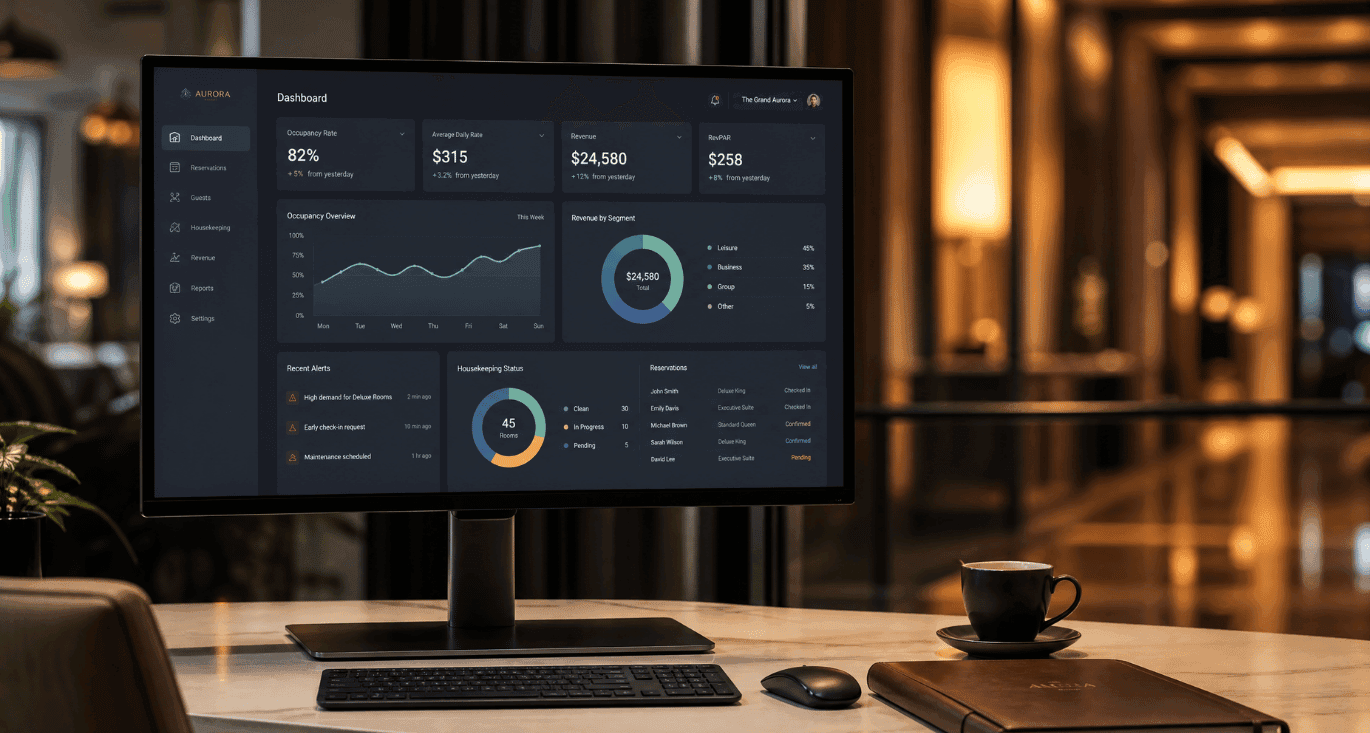
Hotel PMS vendor AI news Q2 2026: Wyndham's ChatGPT app, Choice Hotels x AWS, and what it means for your stack
Q2 2026 made one truth unavoidable: chains and PMS vendors are racing ahead on distribution and operations AI, but the…
How AI is replacing OTA dependency: the data behind hotels' shift to direct bookings
OTAs silently drain hotels of 15-25% per booking, yet AI concierges now convert website traffic, handle multilingual in…

AI pre-arrival calls and upsells: how hotels add 15-25% revenue before guests check in
Discover how hotels are boosting revenue by 15-25% before guests even arrive, thanks to AI-driven pre-arrival calls and…
Ready to Transform Your Hotel?
Book a free strategy call and see exactly how Lynn would work in your property.