
How hotels are actually using AI in 2026 (and what's driving real results)
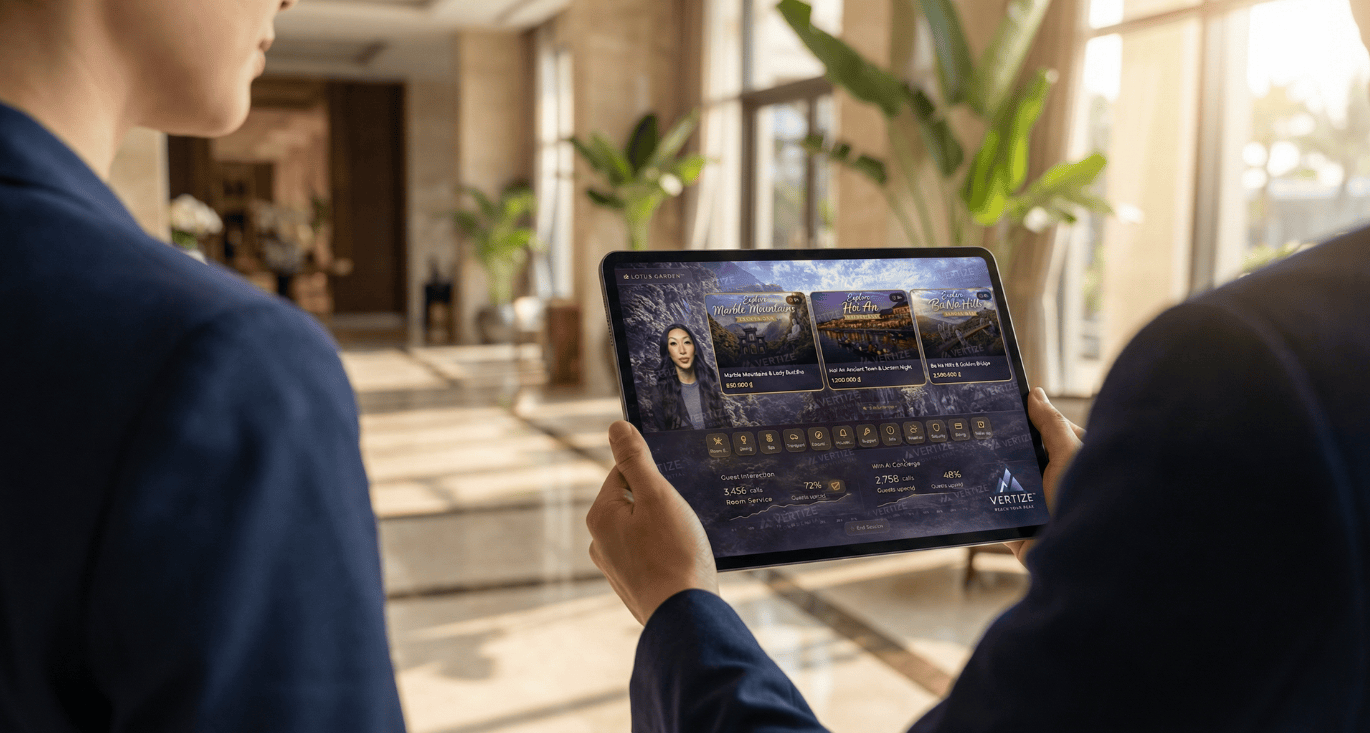
In 2026, AI has become the backbone of hospitality, seamlessly enhancing guest experiences and operational efficiency in hotels worldwide. Vertize is at the forefront, integrating intelligent solutions with existing systems to drive real results, from personalized guest interactions to optimized revenue management.
AI in hospitality has moved past the hype cycle. In 2026, it's no longer about whether hotels should adopt AI. It's about how deeply it's woven into daily operations, guest experiences and revenue strategy. The market for AI in hospitality is projected to reach $2.28 billion by 2030 at a 57.7% compound annual growth rate, and the properties seeing the strongest returns aren't the ones chasing flashy features. They're the ones integrating AI into the systems they already use.
This guide breaks down what's actually working across the hotel industry right now, from guest-facing personalization to behind-the-scenes operations, and how properties of any size can implement these capabilities through their existing PMS and tech stack.
Why is AI adoption in hospitality accelerating so fast?
The short answer: hotels are caught between rising costs and guests who expect more. AI is the only lever that addresses both simultaneously, which is why an estimated 79% of hospitality businesses have either adopted or are actively considering it.
The economic backdrop makes the urgency clear. RevPAR growth in 2025 and 2026 has been modest, mostly driven by higher average daily rates compensating for softer occupancy. Operating costs keep climbing. Staffing remains a challenge industry-wide. In this "two-speed economy," technology isn't a nice-to-have. It's what separates profitable properties from those slowly losing margin.
Three forces are converging to accelerate adoption:
Guest expectations have shifted permanently. About 74% of travelers now want hotels to use AI to tailor services and offers, and 73% prefer properties offering contactless check-in. The pandemic didn't just change behavior temporarily. It reset the baseline for what guests consider a modern hotel experience.
The data infrastructure finally exists. Cloud-based PMS platforms like Oracle OPERA Cloud, Mews, Cloudbeds and Stayntouch have matured to the point where they can feed AI systems with the structured guest data needed for meaningful personalization. Cloud PMS now represents 64.9% of market value and continues growing at 12.4% annually.
The ROI evidence is no longer theoretical. Hotels implementing AI-driven dynamic pricing report 15-25% revenue increases within the first year. AI-powered chatbots deliver up to a 35% increase in booking conversion rates. These aren't projections from vendor slide decks. They're operational results from properties that have moved past the pilot phase.
Yet despite 98% of hotels having begun using AI in some form, only 32% say it's embedded across most of their operations. That gap between experimentation and full integration is where the biggest opportunity sits, and it's exactly the space where solutions like Vertize operate.
How is AI transforming the guest experience in practice?
AI-driven personalization in hotels has evolved from remembering a guest's pillow preference to orchestrating the entire stay. The shift is from reactive service (responding to requests) to anticipatory hospitality (addressing needs before the guest articulates them), and it happens across every phase of the journey.
Before arrival, AI analyzes past booking behavior, stated preferences and even travel context to generate tailored offers. A returning business traveler might receive a curated package with late check-out and workspace access, while a couple booking an anniversary trip gets spa recommendations and dining options. This isn't manual segmentation by a marketing team. It's automated, real-time profiling powered by what the industry now calls Intelligent Guest Profiles.
At check-in, the experience becomes tangible. AI systems can identify a guest's loyalty tier, room preferences and any outstanding service requests from previous stays, surfacing this information to front desk staff or enabling contactless check-in that already reflects those preferences. Properties using AI-powered check-in report significantly reduced wait times and higher guest satisfaction scores.
During the stay, context-aware AI recommendations are achieving 45% conversion rates compared to 12% for traditional upselling approaches. This covers everything from in-room dining suggestions timed to the guest's schedule, to spa promotions triggered by weather conditions, to local activity recommendations based on travel purpose.
After departure, automated sentiment analysis processes guest feedback to identify patterns and improvement areas, feeding insights back into the system so the next stay is even more personalized.
The luxury segment calls this "invisible hospitality." Instead of requiring guests to configure preferences through an app, AI learns from behavior patterns, time of day and trip purpose. A business traveler arriving late after a long flight finds their room already set to a comfortable temperature with dimmed lighting and a quiet ambiance. No buttons pressed, no settings adjusted.
But there's an important nuance that the best implementations respect: guests still want human connection for emotionally complex situations. A 2026 study found that 81% of respondents identified emotional authenticity as a critical challenge for AI adoption. The generational split is dramatic too, with 78% of Gen Z preferring an AI concierge for instant needs while only 23% of Baby Boomers are comfortable with it. The smartest approach gives guests the choice rather than forcing a single channel.
This is where Vertize's AI concierge Lynn fits naturally. Lynn handles the routine, high-volume guest interactions (check-in details, facility questions, service requests, multilingual support) around the clock, while freeing up human staff to focus on the moments that actually require empathy and judgment. It's not replacement. It's redistribution of attention.
What's happening behind the scenes that guests never see?
The guest-facing applications get the headlines, but the most significant margin impact happens in back-of-house operations. AI is becoming the operational nervous system for daily hotel activities, and the savings are substantial.
Predictive maintenance and IoT
Hotels are increasingly equipped with sensors monitoring HVAC systems, elevators, lighting and room occupancy in real time. AI-driven predictive maintenance uses this data to flag problems before they become visible to guests. A sensor might detect irregular energy consumption in an air conditioning unit, triggering a maintenance appointment two to four weeks before the system actually fails.
The results are meaningful: a 20-30% reduction in maintenance costs, 40-50% fewer emergency repairs, extended equipment lifespan, and improved guest satisfaction from preventing service interruptions. For a 200-room property, this translates to tens of thousands saved annually.
Energy management as a margin strategy
Sustainability has evolved from a marketing message to a core margin strategy. AI-powered energy management systems automate temperature control, lighting and water usage based on actual occupancy. Energy isn't wasted in unoccupied rooms, and consumption adjusts dynamically based on factors like outside temperature and guest preferences.
Hotels implementing these systems are seeing savings of $350 to $500 per room annually. For a mid-sized property, that's a direct impact on the bottom line without touching the guest experience negatively.
Intelligent procurement
On the supply chain side, AI is transforming how hotels manage vendor relationships and purchasing. Generative AI can draft Requests for Proposals in minutes instead of hours, while machine learning algorithms automatically match properties with the best suppliers based on historical performance data and specific needs. Vertize's intelligent procurement tools address exactly this operational blind spot, bringing enterprise-grade efficiency to properties that previously managed these processes manually.
How is AI changing hotel revenue management?
AI-powered revenue management represents one of the clearest ROI stories in hospitality technology. Dynamic pricing engines now analyze hundreds of variables in real time, including competitor rates, local events, weather forecasts and social media sentiment, to optimize room pricing for maximum yield.
During low-demand periods, AI suggests competitive rates to maintain occupancy. During high-demand windows like major sporting events or conferences, it ensures pricing captures full value without pushing the property out of the market. For independent hotels that can't afford a full-time revenue manager, these tools are transformative. AI-driven RMS implementations are delivering 10-20% increases in RevPAR and saving more than 30 hours of manual work per month.
The direct booking optimization angle is equally important. Hotels are redesigning their commercial strategies to strengthen the direct guest relationship and reduce OTA dependency. AI simplifies the booking journey by showing real-time availability, filtering rooms by guest preferences and offering instant rate comparisons. This reduces bounce rates and improves conversion on the hotel's own channels.
Revenue strategy | How AI applies | Typical result |
|---|---|---|
Dynamic pricing | Real-time analysis of demand signals, competitor rates and market conditions | 10-20% RevPAR increase |
Booking conversion | Personalized widgets, price comparison tools, preference-based filtering | Higher share of direct bookings |
Demand forecasting | Analysis of historical patterns combined with forward-looking event data | Better staffing and inventory decisions |
Upselling | Context-aware upgrade offers during booking and check-in | 45% conversion rate vs. 12% traditional |
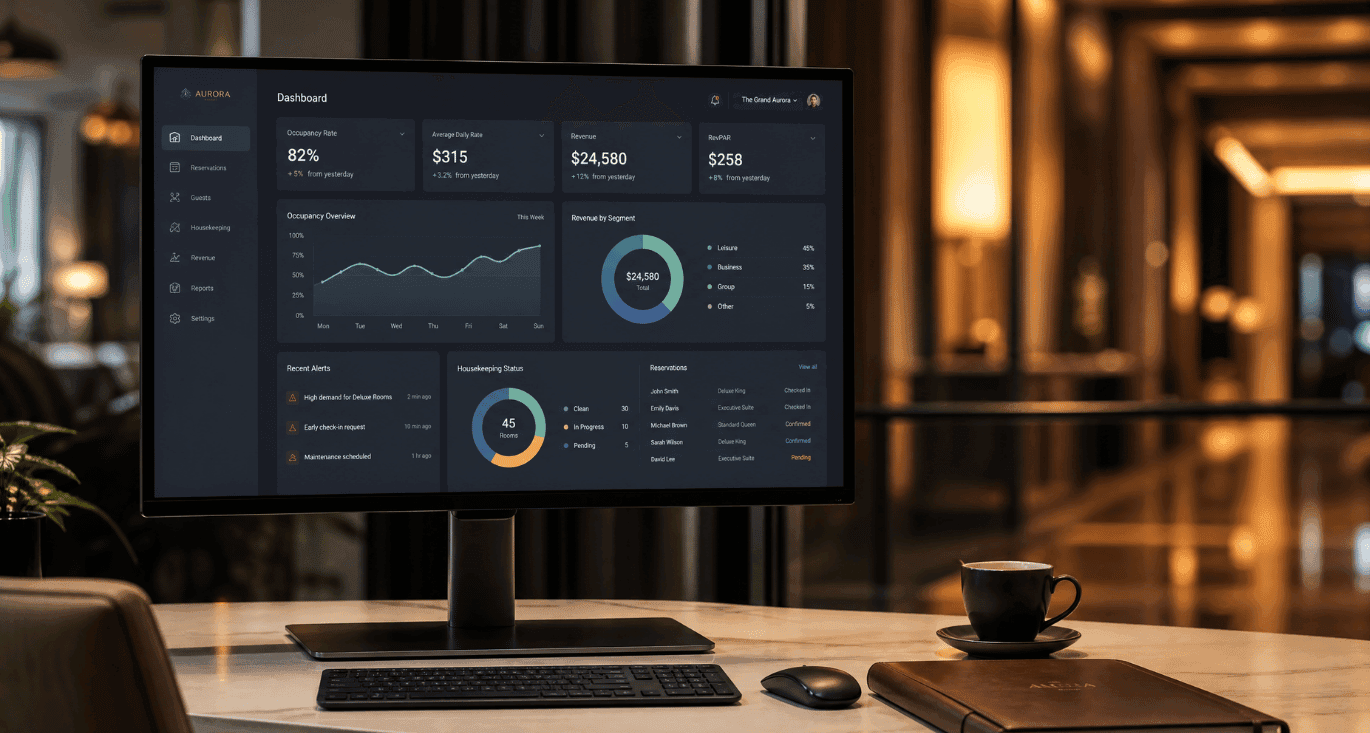
What makes this work is the connection between AI and the property management system. Without clean, structured data flowing from the PMS, AI pricing tools are working with incomplete information. This is why the integration layer matters so much, and why Vertize builds solutions that connect directly with the PMS platforms hotels already run on, including Oracle OPERA Cloud, Mews, Cloudbeds and Stayntouch.
Why does PMS integration matter so much for hotel AI?
Here's the uncomfortable truth about AI adoption in hospitality: most hotels operate with fragmented data spread across disconnected systems. Their PMS holds reservation data. Their CRM stores guest preferences. Their channel manager tracks distribution. Their RMS handles pricing. And none of these systems talk to each other fluently.
Only 1 in 3 hotel operators trust the data in their current systems. That's not a technology problem. It's an integration problem. And it's the single biggest barrier to getting meaningful results from AI.
AI systems are only as good as the data they can access. When a property's PMS, CRM and operational systems are siloed, the AI can't build complete guest profiles, can't optimize pricing with full demand context and can't deliver the personalized experience guests now expect.
This is where Vertize positions itself differently from both PMS vendors and standalone AI tools. Rather than requiring hotels to rip out their existing systems, Vertize acts as the intelligent layer that connects across platforms. It integrates with major PMS systems to unify guest data, automate communications across channels (SMS, WhatsApp, in-app chat), and ensure every interaction is connected to the guest's identity and history. No more anonymous, fragmented conversations.
For small and mid-sized properties especially, this approach is critical. Enterprise chains can afford custom integrations and dedicated IT teams. Independent hotels and boutique properties need a solution that works with what they already have. Vertize democratizes capabilities that were previously only accessible to major brands, from automated inventory management and AI-driven marketing campaigns to unified guest messaging.
What's coming next: voice and agent-to-agent distribution
Two emerging trends will reshape hospitality further in the coming years, and forward-thinking hotels are already preparing.
Voice technology is advancing faster than most hoteliers realize. Thanks to improvements in large language models, today's voice systems can understand intent and handle multi-step requests. Guests can book rooms, request services or explore hotel amenities simply by speaking naturally. Hotels investing in voice AI early are reducing friction and creating new opportunities for bookings and upsells.
Vertize's AI voice assistant capabilities are built with this trajectory in mind, handling guest calls 24/7 with natural conversation quality that goes far beyond the rigid phone trees of the past.
Agent-to-agent distribution is perhaps the most forward-looking shift. In this model, a traveler's personal AI agent communicates directly with a hotel's AI system to negotiate rates, check availability and match preferences. The hotel's visibility no longer depends solely on human decision-making. It depends on how well the property's data can be consumed and processed by other AI systems.
This connects directly to the visibility challenge. Just as search engine optimization determined discoverability in the 2010s, AI-readability will determine discoverability in the late 2020s. Hotels that lack structured data, rich schema markup and machine-readable content risk being excluded from AI-generated recommendations entirely. If an AI system can't read your property's data, it can't recommend your property.
How should hotels approach AI implementation in 2026?
For properties that haven't yet moved beyond basic AI experimentation, here's a practical framework based on what's working across the industry.
Start with your PMS. Your property management system is the foundation. Ensure it's cloud-based, API-enabled and capable of feeding data to external AI tools. If you're running a legacy on-premise system, the migration to cloud PMS should be priority one, because nothing else works without it.
Audit your data quality. AI amplifies the quality of your data, for better or worse. Before layering AI tools on top, clean up your guest profiles, standardize your data fields and eliminate duplicates. This isn't glamorous work, but it's what separates properties that get real results from those that get disappointed.
Pick use cases with clear ROI. Don't try to implement everything at once. Revenue management (dynamic pricing), guest messaging (AI chatbots and concierge) and energy management consistently show the fastest payback periods. Hilton runs 41 distinct AI use cases across 7,500 properties, and three of them paid back within six months. Start with the use cases most relevant to your operation.
Choose integration-first solutions. Avoid AI tools that require you to rebuild your tech stack. Look for providers like Vertize that work with your existing PMS and operational systems, adding an intelligent layer on top rather than demanding a replacement underneath.
Measure and iterate. Track the metrics that matter: RevPAR change, direct booking share, guest satisfaction scores, operational cost per room, staff time saved. Review quarterly and adjust.
Frequently asked questions
What percentage of hotels are using AI in 2026? An estimated 98% of hotels have begun using AI in some capacity, but only about 32% report having AI embedded across most of their operations. The gap represents a major opportunity for deeper integration, particularly through PMS-connected AI solutions.
How much does AI increase hotel revenue? Hotels implementing AI-driven dynamic pricing typically see 15-25% revenue increases within the first year. AI-powered chatbots can boost booking conversion rates by up to 35%, and context-aware upselling achieves conversion rates of 45% compared to 12% with traditional methods.
Can small independent hotels afford AI implementation? Yes. Cloud-based AI solutions have dramatically lowered the barrier to entry. Providers like Vertize specifically serve independent and boutique properties, offering enterprise-grade AI capabilities (guest messaging, revenue optimization, operational automation) at price points accessible to smaller operations.
Which hotel PMS platforms work best with AI tools? The major cloud PMS platforms (Oracle OPERA Cloud, Mews, Cloudbeds, Stayntouch, Infor HMS) all support AI integrations through their API ecosystems and marketplace partners. The key differentiator is how well the AI solution connects with your specific PMS. Vertize integrates across these platforms, acting as the intelligence layer that bridges your existing systems.
Do hotel guests actually want AI-powered experiences? Research shows 74% of travelers want hotels to use AI for tailored services, and 86% appreciate AI-based personalization. However, preferences vary by generation and interaction type. Most guests prefer AI for quick, routine tasks and 24/7 availability, while valuing human interaction for emotionally nuanced situations.
How is AI changing hotel discoverability and marketing? AI-powered search engines and assistants (Google AI Overviews, ChatGPT, Perplexity) are changing how travelers find hotels. Properties with structured data and machine-readable content are more likely to be surfaced in AI-generated recommendations. Hotels without proper schema markup and data structure risk becoming invisible to these new discovery channels.
Vertize builds AI solutions specifically for the hospitality industry, from intelligent guest-facing assistants to operational automation tools that integrate with your existing PMS. Explore how Vertize can transform your property's operations →
Related posts
AI guest messaging for hotels: channels, results, and what guests actually prefer
AI guest messaging is revolutionizing hospitality, with 92% of hotels adopting or planning to implement this technology…
Hotel PMS vendor AI news Q2 2026: Wyndham's ChatGPT app, Choice Hotels x AWS, and what it means for your stack
Q2 2026 made one truth unavoidable: chains and PMS vendors are racing ahead on distribution and operations AI, but the…

What is an AI-native PMS in 2026? (And why most hotels still need an AI layer on top)
In 2026, an AI-native Property Management System (PMS) is defined by machine learning embedded at its core, revolutioni…
Ready to Transform Your Hotel?
Book a free strategy call and see exactly how Lynn would work in your property.