How AI is replacing OTA dependency: the data behind hotels' shift to direct bookings
OTAs silently drain hotels of 15-25% per booking, yet AI concierges now convert website traffic, handle multilingual inquiries, and drive pre-arrival upsells at a fraction of that cost. For a 100-room property, shifting just 10% of OTA volume to direct can deliver $67,000 in annual savings with Vertize AI's Lynn leading the charge.
How AI is replacing OTA dependency: the data behind hotels' shift to direct bookings
TL;DR: OTA commissions cost hotels 15-25% of every booking, with hidden fees pushing the true impact to 25-36%. AI concierges, voice agents, and pre-arrival messaging are now mature enough to replace that expense at a fraction of the cost. A 100-room hotel shifting 10% of OTA bookings to direct can net roughly $67,000 in annual savings with a 4-5 month payback.
The OTA dependency conversation has shifted. For most of the last decade, hotels accepted commissions of 15 to 25% as a structural cost of doing business. AI changes the math. A modern AI concierge layer can convert website visitors, handle multilingual inquiries, run pre-arrival upsells, and resolve inbound voice calls for a fraction of what OTAs charge per booking. This post focuses on what OTAs actually cost and how AI replaces that expense. For the complementary angle on how AI capabilities translate to more direct bookings, see how AI concierges drive direct hotel bookings.
What do OTAs actually cost your hotel per year?
OTAs cost hotels far more than the headline commission rate suggests. Booking.com charges roughly 15-25% per booking (Genius levels can push effective cost to 25-36%), while Expedia averages 19.2% according to industry data. Layer on rate-parity constraints, preferred-partner fees, sponsored-listing spend, and the implied opportunity cost of guest-data loss, and the real annual burden for a typical 100-room hotel can exceed $700,000.
Consider the math for a 100-room property running 70% occupancy at a $150 ADR. That is roughly 25,550 room-nights per year. Assume 35% of those nights come through OTAs, which is a conservative industry average. At a 20% blended commission rate (Booking.com plus Expedia plus smaller channels), the property pays roughly $268,275 per year in direct commissions on OTA-sourced room revenue alone.
Hidden costs make it worse. OTAs spent more than $20 billion on marketing in 2024-2025, much of it bidding on the hotel's own brand terms, which forces hotels to either pay for branded-search ads themselves or lose those guests to the OTA. Genius and Preferred Partner programs reduce visibility for hotels that opt out, creating a soft cost that does not appear on any invoice. OTA-sourced bookings also have meaningfully higher cancellation rates (industry research consistently shows ~22% for OTA versus ~10.6% for direct), which inflates operational cost per actual stay.
The strategic implication is that the real annual cost of OTA dependency for a 100-room hotel is closer to $400,000-$700,000 once hidden costs are included, not the $268,000 the commission line item suggests. That is the spend AI now plausibly displaces. For context on hotel AI ROI in general, see hotel revenue through AI upselling.
Why do hotels stay dependent on OTAs despite the cost?
Hotels stay dependent on OTAs because the channels still solve real distribution problems: international visibility, multilingual booking, payment handling, and the so-called "billboard effect" where OTAs drive brand discovery that converts later on the hotel's own site. The honest answer is that OTAs are not all cost; they are a paid distribution layer that has historically been hard to replicate.
Three reasons drive ongoing dependency. The first is multilingual reach. A traveler in Seoul or São Paulo searching in their own language is more likely to find Booking.com than an independent hotel's English-only site. The second is the billboard effect, which Cornell research has documented for years: travelers find a hotel on an OTA, then book direct. The third is operational simplicity. OTAs handle currency conversion, payment processing, and most cancellations, which is real value for a small property.
These reasons are still valid. Where they are weakening is the gap between them and what an AI-powered direct channel can now do. Multilingual reach is solvable with an AI concierge that converses in 50+ languages. The billboard effect remains real, but the marginal value of the OTA falls as a hotel's GEO and AI search visibility improve. Payment and currency handling is built into modern booking engines. The structural reasons for OTA dependency have not disappeared, but they have shrunk, and they will keep shrinking. For how language coverage drives conversion, see multilingual AI as a direct booking enabler.
How does AI specifically reduce OTA dependency?
AI reduces OTA dependency by attacking the specific friction points that push travelers to OTAs in the first place. Five mechanisms matter most: website chat that converts browsers, multilingual AI that removes language barriers, pre-arrival messaging that reduces cancellations and adds revenue, AI voice agents that convert inbound calls, and AI search visibility (GEO) that builds a new direct discovery channel.
Website chat. AI concierges on hotel websites resolve guest questions in real time, in the language they are asking in, with PMS-connected answers about availability, rates, and policies. Conversational AI conversion rates of around 30% on engaged visitors are widely reported. That converts traffic that previously bounced back to Booking.com.
Pre-arrival messaging. AI-driven pre-arrival sequences (WhatsApp, email, SMS) reduce cancellations, drive ancillary revenue (room upgrades, parking, F&B), and warm up the guest relationship in their language. For specifics on the revenue uplift, see AI pre-arrival calls and upsells.
Multilingual AI. Most independent hotels lose international direct bookings because their website and front desk cannot converse in the guest's language. AI concierges that handle 50+ languages erase that barrier without staff cost.
AI voice agents. Industry data suggests AI voice can resolve roughly 70% of inbound calls autonomously, capturing direct bookings from travelers who would otherwise abandon the call or default to an OTA.
GEO and AI search visibility. As AI search engines (ChatGPT, Gemini, Perplexity, Google AI Mode) become primary discovery surfaces, hotels with strong GEO appear in the AI's two- or three-property answer, driving direct traffic that bypasses the OTA funnel entirely.
The integrated effect is significant. Properties combining these mechanisms typically report direct-share gains of 10-20% within the first 12 months, with margin gains larger than the revenue numbers suggest because direct bookings carry no commission. For the broader operational picture, see AI guest messaging channels and results.
What does an AI concierge cost compared to OTA commissions?
An AI concierge typically costs in the range of $1.25 to $9.99 per room per month, or a flat monthly fee of $39-$99 for the smallest properties, depending on capabilities, language coverage, integration depth, and volume. For a 100-room hotel that is roughly $1,500-$10,000 per year in AI concierge spend. Compared to $268,000-$700,000 in annual OTA cost, the math is striking.
The business case is straightforward. A 100-room hotel paying around $5,000 per year for an AI concierge layer that shifts 10% of its OTA bookings to direct saves roughly $67,000 per year net, after subtracting the AI cost and accounting for the marginal customer-acquisition spend required to drive direct demand. The payback period is 4-5 months in most modeled scenarios.
Larger properties scale the case rather than dilute it. A 200-room hotel running similar mechanics typically sees gross annual savings in the six figures with similar payback. An AI concierge like Vertize's Lynn, connected to the hotel's PMS, converts website visitors to direct bookers in 50+ languages while generating upsell revenue that OTA commissions would otherwise consume.
Cost component | Booking.com (20% commission) | Expedia (18% commission) | Direct with AI concierge |
|---|---|---|---|
Commission rate | 20% | 18% | 0% (AI cost replaces commission) |
Average commission per booking ($150 ADR, 2-night stay) | $60 | $54 | $0 |
Annual bookings (100-room, 70% occ, 35% OTA share) | ~3,000 | ~1,500 | Variable by direct strategy |
Annual commission cost | ~$180,000 | ~$81,000 | ~$5,000 (AI concierge) |
Hidden costs (brand bidding, parity, cancellations) | $40,000-$80,000 | $20,000-$40,000 | Marginal direct marketing spend |
Total annual cost | $220,000-$260,000 | $101,000-$121,000 | $20,000-$60,000 |
Cost per room per year | $2,200-$2,600 | $1,010-$1,210 | $200-$600 |
The table is intentionally conservative. Real-world cases (United and American Airlines have publicly reported direct-booking shares of 70% and 55% respectively after sustained AI-driven direct investments) suggest the maximum direct share is meaningfully higher than what most hotels achieve. For the broader investment framing, see what an AI concierge is and how it works.
Which hotels have actually reduced OTA dependency using AI?
Several large-hotel case studies document measurable OTA-dependency reductions tied to AI-driven direct investments. Hilton's Connie program reportedly drove around 50% uplift in direct bookings in pilot properties. Ritz-Carlton reported approximately 15% cart-recovery from AI-driven pre-arrival messaging. French Lick Resort publicly reported about 800 incremental direct bookings driven by AI chat after launch.
The strongest parallel is the airline industry. Both United Airlines and American Airlines have publicly reported direct-booking shares of around 70% and 55% respectively after years of investment in direct technology, loyalty integration, and AI-driven personalization. The shift was not overnight, but the trajectory has been steady and material. Hotels are 4-6 years behind airlines in the same shift, which is both a warning and an opportunity.
In the boutique and small-chain segment, public case studies are less common but the pattern is similar. Properties that combine an AI concierge, AI voice handling, multilingual content, and GEO typically report direct-share gains of 10-20% in the first year and continued gains in years two and three. The biggest variable is not the technology; it is whether the hotel's website, content, and AI search visibility are strong enough to capture the demand the AI layer is helping convert. For the GEO side of the story, see how AI cuts OTA dependency through search visibility.
What is a realistic timeline for reducing OTA bookings by 10-20%?
A realistic timeline for shifting 10-20% of OTA bookings to direct using AI is 9-18 months, depending on the starting point. Most hotels see initial direct-share gains within 90 days of launching an AI concierge with PMS integration, with material 10%+ shifts typically taking 6-12 months as content, GEO, and guest behavior compound.
A practical roadmap looks like this. Months 1-3: Launch the AI website chat with PMS integration, audit and fix robots.txt and Bing indexation, publish 10-20 FAQ entries with FAQPage schema, ensure multilingual coverage for the top three source markets. Months 4-6: Add AI pre-arrival messaging (WhatsApp/SMS), enable AI voice for inbound calls, build out GEO content across the top 20 high-intent traveler queries. Months 7-12: Layer in AI upselling, expand multilingual content to five or more languages, optimize content quarterly using AI citation tracking, and aggressively encourage direct-booking review signals.
The variable that matters most is the starting point. A hotel with strong organic SEO, clean PMS data, and active social presence will hit the 10%+ shift target faster than one starting from a neglected website. Either path is faster than the airline industry's decade-plus timeline because the AI tooling is now mature off the shelf. For the data-readiness checklist that determines starting-point speed, see is your hotel PMS ready for AI.
Capability | What OTAs offer | What AI concierge adds | Net effect on direct bookings |
|---|---|---|---|
Multilingual booking | Strong (~40 languages) | Strong (~50+ languages, real-time) | Closes the OTA's language advantage |
24/7 availability | Yes | Yes, with conversational depth | Removes off-hours OTA fallback |
Personalization | Limited (account-based) | Deep (PMS + guest profile) | Direct site outperforms OTA experience |
Upselling | None at booking | Strong (pre-arrival, in-stay) | Net new revenue captured direct |
Price comparison | Strong | Hotel-owned ("best rate guaranteed") | Reduces parity leakage |
Guest data ownership | OTA owns | Hotel owns | Builds repeat-booking pipeline |
Repeat booking | Low (OTA repeats to OTA) | High (CRM + loyalty integration) | Compounding direct-share gains |
Search visibility | Strong (paid + brand bidding) | Growing (GEO + AI citations) | New direct-discovery channel |
Can a hotel ever go fully OTA-free?
Probably not, and that is okay. Even airlines, after a decade of direct-booking investment, have not eliminated indirect distribution entirely. The realistic goal is shifting the ratio, not the absence of OTAs. A hotel that moves from 50% OTA to 30% OTA captures most of the margin gains while keeping the visibility benefits of indirect distribution for international markets and new audience reach.
The right mix depends on segment, geography, and brand strength. Boutique urban properties in well-traveled cities can plausibly hit 70%+ direct share with sustained AI investment. Rural or destination resorts often need OTAs for international visibility into smaller source markets where their brand has no organic awareness. New properties in their first 18 months are also usually right to lean on OTAs for the initial billboard effect, even while building their AI-driven direct channel in parallel.
The strategic framing that holds up best is this: OTAs are a paid distribution channel like any other, with measurable cost and measurable yield. Treat them as one channel in a portfolio, not as the default. Audit them quarterly. Compare commission-equivalent cost against the AI-driven direct cost of acquiring the same booking. Let the math, not the inertia, decide the mix. For the broader strategic context on how hotels are deploying AI, see how hotels are actually using AI in 2026 and WhatsApp, Zalo, and WeChat for hotel guests.
Frequently asked questions
How much do OTAs really cost a 100-room hotel per year?
A 100-room hotel running 70% occupancy at $150 ADR with a 35% OTA share typically pays $200,000-$300,000 per year in direct commissions, plus an additional $40,000-$80,000 in hidden costs (brand bidding, parity, higher cancellation rates). Total burden is usually $250,000-$400,000 per year for a single property.
What is the payback period for an AI concierge focused on OTA reduction?
For a 100-room hotel shifting 10% of OTA bookings to direct, AI concierge payback typically lands at 4-5 months. The math: AI concierge cost of $1,500-$10,000 per year against gross commission savings of roughly $25,000-$30,000 per 10% of shifted bookings net of marginal direct marketing spend.
Can a small independent hotel realistically shift 10% of OTA bookings to direct in year one?
Yes, with a foundational AI investment (website chat with PMS integration, multilingual coverage for top three source markets, AI pre-arrival messaging, basic GEO improvements). Hotels with existing organic SEO and active social presence hit the 10% target faster. Hotels starting from neglected websites need 12-18 months to build the foundation that supports the shift.
Does AI hurt OTA performance or just complement direct?
AI does not directly hurt OTA performance; it makes direct more competitive. OTA bookings that come from international or off-hours audiences may continue at similar volume even as direct share grows, because they were never realistically winnable for direct. The AI shift mostly converts the marginal traveler who was on the fence between direct and OTA.
Should small hotels in remote locations bother with AI to reduce OTAs?
It depends. If the hotel relies on OTAs primarily for international visibility in markets where its brand has zero awareness, the OTA may remain the right channel. If the hotel loses 30%+ of its room revenue to commission and has any reasonable organic discovery, AI investment usually pays back even at small scale.
What is the single biggest AI investment for OTA-dependency reduction?
The single highest-leverage AI investment is a multilingual AI website chat with PMS integration. It captures website traffic that would otherwise bounce to Booking.com, converts in the guest's language at any hour, and produces measurable direct-booking uplift within 90 days. Layer voice and pre-arrival messaging on top once the chat layer is mature.
Will OTAs eventually adapt and stay ahead of hotels' AI shift?
OTAs will adapt, but their economics constrain how aggressively. Their cost-per-booking is roughly the commission they charge, which means they cannot drop pricing without imploding their model. Hotels with strong AI-driven direct channels increasingly hold a structural cost advantage, similar to how airlines moved decisively to direct over the last decade.
Conclusion
OTA commissions are a real, measurable, and increasingly avoidable cost. AI does not eliminate the value of OTAs entirely, but it does shrink their structural advantages and shift the math materially in the hotel's favor. A 100-room property can plausibly net $50,000-$100,000 in annual savings within 12 months by adopting an AI concierge, multilingual coverage, pre-arrival messaging, and basic GEO.
The hotels that move first set themselves up for a compounding direct-share lead. The hotels that wait will continue paying 15-25% of every booking to OTAs while their competitors quietly redirect that spend into AI tooling that pays for itself many times over. The technology is ready. The math is favorable. The remaining question is when, not whether.
Related posts
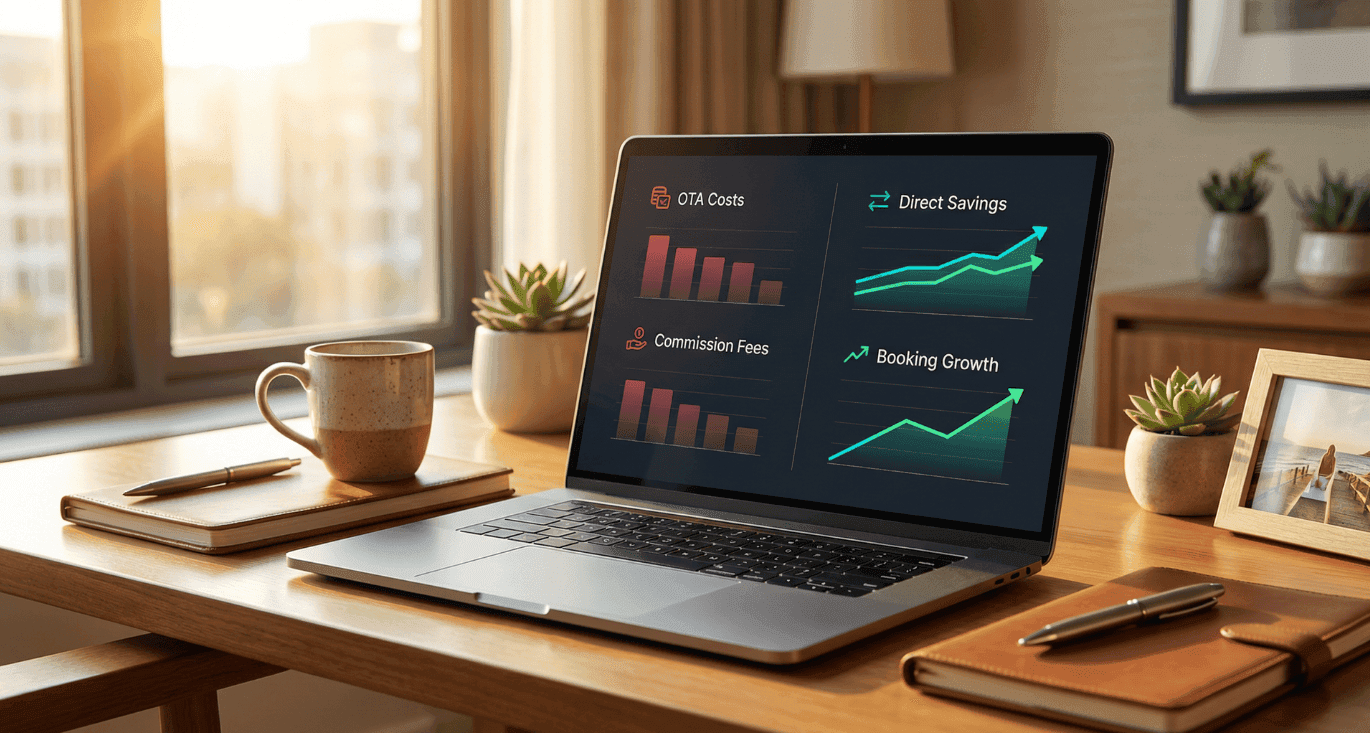
Hotel AI and direct bookings: how AI cuts OTA dependency
Hotels are losing 15-30% of revenue to OTA commissions, but AI offers a game-changing solution to shift bookings to dir…
Why Luxury Hotels Are Replacing Front Desk Staff With AI Concierges
The most innovative luxury hotels aren't cutting corners — they're doubling down on service quality. AI concierges are…
Hotel PMS vendor AI news Q2 2026: Wyndham's ChatGPT app, Choice Hotels x AWS, and what it means for your stack
Q2 2026 made one truth unavoidable: chains and PMS vendors are racing ahead on distribution and operations AI, but the…
Ready to Transform Your Hotel?
Book a free strategy call and see exactly how Lynn would work in your property.