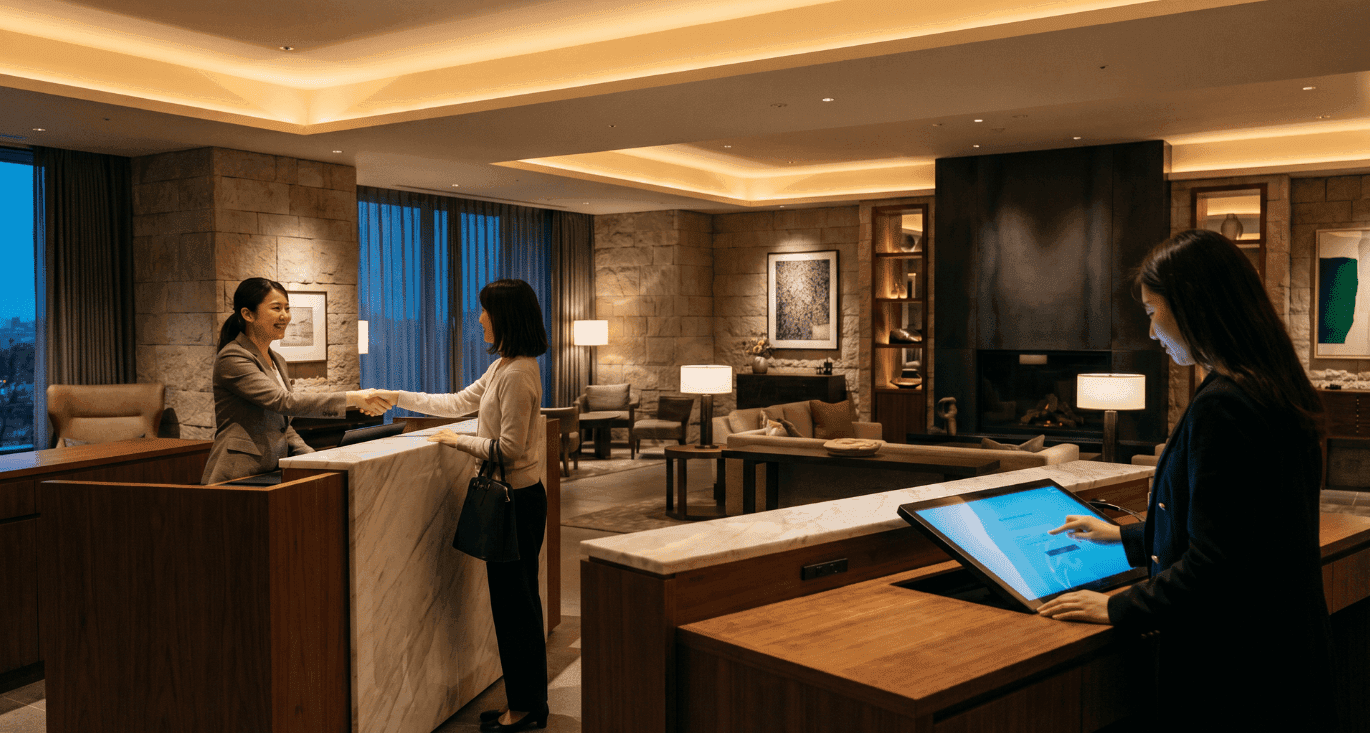
Best AI concierge for your hotel: the 2026 buyer's guide
Discover the ultimate AI concierge for your hotel with Vertize's 2026 buyer's guide, designed to help you navigate the evolving landscape of autonomous systems that integrate seamlessly with your PMS and drive measurable revenue through context-aware upselling. This comprehensive resource provides an evaluation framework, pricing benchmarks, ROI evidence, and critical red flags to ensure you make a confident, future-proof decision.
Best AI concierge for your hotel: the 2026 buyer's guide
TL;DR: The best AI concierge for your hotel is one that integrates bidirectionally with your PMS, handles guest conversations across voice, chat, and messaging in the languages your guests actually speak, and generates measurable revenue through context-aware upselling. This buyer's guide gives you the evaluation framework, pricing benchmarks, ROI evidence, and red flags to make that decision with confidence.
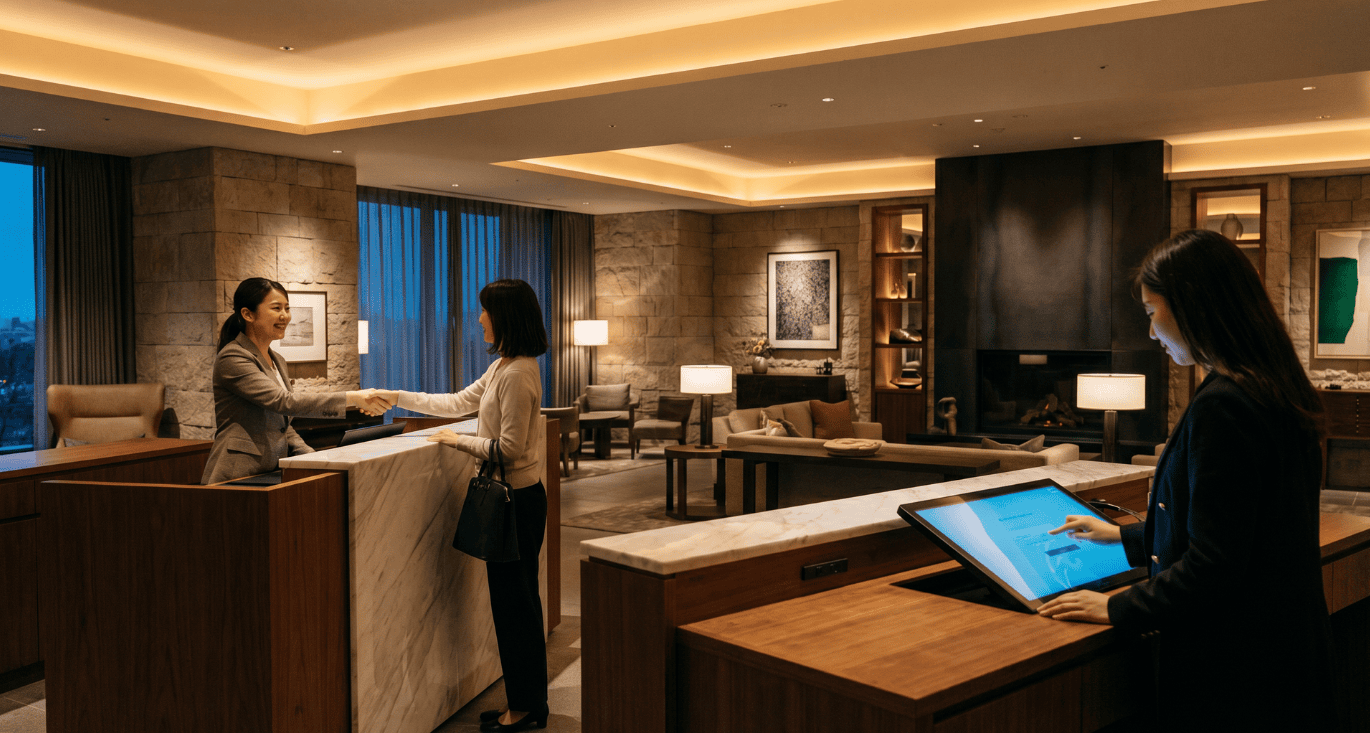
Choosing an AI concierge in 2026 is no longer about picking a chatbot that answers FAQs. The category has matured into autonomous systems that reason about guest requests, execute multi-step tasks inside your property management system, and generate trackable revenue. The challenge is that the market is flooded with vendors whose marketing sounds identical. Every pitch deck promises "seamless integration" and "personalized guest experiences." The difference between a system that pays for itself in three months and one that collects dust sits in the details this guide covers.
What is an AI concierge and why has the category emerged now?
An AI concierge is a guest-facing intelligence layer that sits between your hotel's operational systems and your guests, handling requests autonomously across chat, voice, and messaging channels while reading and writing data to your PMS in real time. Unlike basic chatbots that follow scripted decision trees, an AI concierge reasons about intent, maintains context across multi-turn conversations, and executes tasks like booking spa appointments, approving late checkouts based on occupancy, or posting upgrade charges to a guest's folio without human intervention.
Three forces pushed this category from experimental to essential. First, the labor equation has permanently shifted. Hospitality faces structural staffing shortages, with 20% to 40% of incoming calls going unanswered at understaffed properties (Hospitality Net, 2025). An AI concierge that captures 100% of those calls recovers revenue that simply evaporates today. Second, generational guest expectations have diverged sharply. 78% of Gen Z travelers prefer AI concierge for instant needs, while 81% of all guests now expect digital service options. Third, the economics have crossed the tipping point: 78% of global hotel chains have deployed some form of AI, and the hospitality AI market is growing at a 57.6% CAGR toward $2.28 billion by 2030.
If you need a primer on what an AI concierge actually does or how it differs from chatbots and voice agents, start there.
What capabilities separate a serious AI concierge from a basic chatbot?
The difference comes down to depth of reasoning, breadth of channels, and whether the system can take action inside your PMS or only read from it. A chatbot follows pre-built scripts and fails when guests deviate from expected phrasing. A serious AI concierge understands that "can I stay a few hours more on Sunday?" means "late checkout," checks next-day occupancy via the PMS, applies your property's approval rules, and confirms the extension, all without a staff member touching anything.
Agentic reasoning and multi-turn context
The capability that most sharply separates categories is agentic reasoning. When a guest asks for restaurant recommendations, follows up with "do they have a kids' menu?" and then says "book it for seven," the AI must connect all three messages and recognize that "it" refers to a restaurant discussed two exchanges ago. Systems that lose context after a single exchange are chatbots wearing a concierge label.
Bidirectional PMS integration
Read-only integration means the AI can greet a guest by name. Bidirectional integration means the AI can create reservations, post charges to folios, process room upgrades, and update guest profiles. This is the difference between a system that informs and one that acts. Understanding how AI integrates with major PMS platforms will help you evaluate whether a vendor's "PMS integration" claim means real write access or just a one-way data feed.
Multilingual depth beyond language count
Many vendors advertise 100+ languages. The question that matters is how well the AI handles each one. True multilingual depth means understanding regional dialects, colloquialisms, and mixed-language patterns like Hinglish (Hindi-English blends) or mid-sentence language switching common among European travelers. For voice interactions, look for a Mean Opinion Score (MOS) of 4.0 or higher, indicating near-human naturalness. Below 3.5, guests disengage. Explore why language depth matters more than language count for the full picture.
Omnichannel presence
A 2026 AI concierge must meet guests on the channels they already use: WhatsApp, SMS, email, phone, web chat, and regional platforms like LINE, WeChat, or Zalo. Voice deserves particular attention. It remains the highest-intent channel, and an AI that answers 100% of calls with zero hold time captures booking moments that vanish when calls go to voicemail.
Revenue generation through contextual upselling
The AI should not simply suggest upgrades. It should check availability, quote the price differential, process the transaction, and update the folio within the conversation. Context-aware AI upselling achieves conversion rates near 45%, compared to 12% for traditional approaches (Hospitality Technology, 2025). The upselling conversion data by channel breaks this down by property type.
Table 1: Capability evaluation framework
Capability | What it means in practice | Why it matters to revenue or operations | How to verify |
Agentic reasoning | AI follows multi-step procedures, checking occupancy before approving a late checkout or verifying allergy records before recommending a restaurant | Deflects up to 80% of routine inquiries without staff intervention | Request a demo of a conditional request with branching logic |
Bidirectional PMS sync | AI creates, reads, updates, and deletes data in the PMS, not just reads it | Prevents overbookings; automates folio charges and room moves | Verify write access with your specific PMS version during a sandbox test |
Multilingual depth | AI handles regional dialects, mixed-language patterns, and cultural context, not just translation | Captures bookings from diverse international markets where basic translation loses nuance | Test with a non-native speaker using colloquial phrasing in a live scenario |
Omnichannel coverage | Native support across WhatsApp, SMS, voice, web chat, email, and regional messaging apps | Guests engage on their preferred channel; no inquiry falls through the cracks | Confirm each channel runs through the same AI engine, not separate tools stitched together |
Context-aware upselling | AI offers upgrades and add-ons based on stay purpose, guest history, and real-time availability | Increases ancillary revenue per occupied room by 15% to 23% | Audit the trigger logic: when does the AI offer what, and what data drives the decision |
Sentiment detection | AI monitors tone, keywords, and patterns for frustration, urgency, or anger | Routes distressed guests to human staff before complaints escalate | Simulate a frustrated call during a sandbox test and see if the handoff triggers |
Unified inbox | Consolidates voice, WhatsApp, SMS, email, and OTA messages into one staff dashboard | Reduces average response time from 47 minutes to under 2 minutes | View the staff dashboard during a simulated peak-volume period |
Knowledge base management | Staff can update restaurant hours, spa availability, or policies in real time | Ensures the AI never gives outdated information or invents ("hallucinates") answers | Change a detail and verify the AI reflects it within minutes |
Secure payment processing | AI generates PCI-compliant payment links within the conversation flow | Captures revenue instantly for bookings, upgrades, and ancillary services | Verify integration with your specific payment gateway |
Guest profile continuity | AI remembers preferences across stays: room type, pillow firmness, dietary restrictions | Repeat guests feel recognized without repeating themselves, driving loyalty and direct rebooking | Ask whether data persists in a unified guest profile across properties and stays |
What technical and compliance requirements should you verify before signing?
Before evaluating features, verify the technical foundation. An AI concierge handles sensitive personal data, operates as business-critical communication infrastructure, and must meet data protection laws across every jurisdiction your guests come from. Gaps here create legal exposure that no feature set can compensate for.
Data security and privacy posture
Demand specifics. The vendor should operate as a Data Processor under GDPR, with your hotel retaining Data Controller status. Ask for SOC 2 Type II certification. For European properties, verify EU data residency. Encryption should use AES-256 at rest and TLS 1.3 in transit. If the vendor cannot produce these credentials, treat that as disqualifying. Before procurement, data readiness before you buy is worth working through.
Latency and uptime SLAs
For voice AI, latency determines whether the system feels helpful or frustrating. Sub-300ms time-to-first-byte (TTFB) is excellent; 300ms to 500ms is acceptable; above 800ms, guests speak over the AI, causing confusion and hang-ups. For uptime, a business-critical guest communication channel should carry a 99.9% SLA (maximum 8.7 hours of downtime per year).
API architecture
Understand the difference between real-time webhooks and batch syncing. If a guest requests a room change, the AI must know the current PMS state, not the state from 15 minutes ago. Webhooks deliver real-time data. Batch syncing introduces delays that lead to overbookings and incorrect information.
Hallucination mitigation
AI systems can invent plausible but fabricated information: a rooftop bar that does not exist, or a room rate never quoted. Serious vendors use retrieval-augmented generation (RAG), forcing the AI to ground every answer in your property's verified knowledge base. Ask how the system handles questions it cannot answer. The correct behavior: it says it does not know and escalates.
Table 2: Must-have vs nice-to-have capabilities by property segment
Capability | Boutique / independent | Midscale chain | Upscale / luxury | Resort | Convention hotel |
Brand voice customization | Must-have | Nice-to-have | Must-have | Nice-to-have | Nice-to-have |
High call volume handling | Nice-to-have | Must-have | Must-have | Nice-to-have | Must-have |
Deep concierge knowledge | Must-have | Nice-to-have | Must-have | Must-have | Nice-to-have |
Regional dialect support | Nice-to-have | Must-have | Must-have | Must-have | Must-have |
Bidirectional PMS integration | Must-have | Must-have | Must-have | Must-have | Must-have |
Group and event lead qualification | Nice-to-have | Nice-to-have | Nice-to-have | Nice-to-have | Must-have |
In-room voice control | Nice-to-have | Nice-to-have | Must-have | Must-have | Nice-to-have |
Activity and experience upselling | Nice-to-have | Nice-to-have | Must-have | Must-have | Nice-to-have |
Sentiment detection and routing | Nice-to-have | Must-have | Must-have | Must-have | Must-have |
24/7 after-hours coverage | Must-have | Must-have | Nice-to-have | Must-have | Must-have |
GDPR and PCI compliance | Must-have | Must-have | Must-have | Must-have | Must-have |
Guest profile continuity across stays | Nice-to-have | Must-have | Must-have | Must-have | Nice-to-have |
How are AI concierges typically priced and what should you negotiate?
Pricing in the AI concierge market varies widely, and the listed price is rarely the complete cost. Most vendors use one of five commercial models, each with distinct risks depending on your property's occupancy patterns and revenue strategy.
Implementation costs sit on top of the subscription. Budget for 20 to 30 hours of staff training and a phased rollout spanning four to eight weeks: knowledge base configuration first, then a soft launch to direct-booking guests, then full deployment. The build vs buy considerations for PMS AI tools add useful context.
What to verify in any vendor contract
Standard cloud service agreements vary widely. The vendors worth working with make these terms straightforward, but it pays to know what to look for. Check the termination window (typically 30 to 90 days notice), confirm data portability and exit rights (your prompt libraries and knowledge base content should be exportable in a machine-readable format), and review renewal terms. Transparent vendors will walk you through every clause before you sign.
Table 3: Pricing model comparison
Model | How it works | Best-fit property profile | Key considerations | What to ask your vendor |
Per-room-per-month (PRPM) | Flat subscription based on room count, typically $100 to $300 for midscale and $300 to $500 for luxury | Chain-affiliated or large city hotels with stable occupancy | Cost stays flat regardless of seasonal occupancy swings | Whether seasonal rate adjustments or multi-property discounts are available |
Per-conversation or per-minute | Variable cost based on guest engagement volume, with voice typically $0.07 to $0.17 per minute | Boutique hotels or seasonal resorts with fluctuating occupancy | Monthly costs scale with volume; verify how internal test conversations are handled | Whether a monthly spend cap is included and how test traffic is excluded |
Revenue share | Vendor takes a percentage of sales generated through AI-assisted upselling | Luxury resorts with high ancillary revenue potential | Attribution methodology matters; clarify what counts as "AI-assisted" | How revenue attribution is tracked and reported transparently |
Flat subscription | Single monthly fee regardless of conversation or room volume | Convention hotels with high, predictable traffic | Value depends on staff adoption and actual usage | Whether regular optimization reviews and knowledge base updates are included |
Hybrid | Base subscription plus a usage-based or success-based fee component | High-occupancy properties with aggressive ancillary revenue goals | More complex billing; request clear monthly reporting | Whether the base fee is locked for the full contract term |
What ROI can you actually expect from an AI concierge in year one?
Properties that implement an AI concierge with bidirectional PMS integration and contextual upselling typically see return on investment within three to six months, driven by three levers: direct booking conversion, ancillary revenue growth, and operational cost reduction. The returns are measurable and attributable, which separates this category from earlier chatbot experiments that could only report "conversations handled."
Revenue generation
AI-driven website and messaging interactions produce a 20% to 35% lift in direct booking conversions by providing instant pricing and availability (Skift Research, 2025). Context-aware upselling generates a 23% increase in revenue per occupied room. Voice AI captures 80% more leads than traditional voicemail. Lynn, Vertize's AI concierge, has demonstrated these conversion rates across properties running on Oracle OPERA Cloud, Mews, Cloudbeds, and Stayntouch by executing upsells within the conversation itself, not just suggesting them. The data on how AI reduces OTA dependency quantifies the direct booking impact further.
Operational efficiency
AI handles 40% to 60% of routine phone calls and up to 85% of routine messaging inquiries without staff involvement. Properties report a 40% reduction in front desk workload, which does not mean cutting 40% of the team. It means staff spend their time on high-value interactions, complex problem solving, and personal service that drives five-star reviews. Labor savings of 10% to 15% come through smarter scheduling and eliminating redundant overnight shifts. Lynn's deployment across multiple PMS platforms shows how a single AI layer handles guest communication around the clock while freeing staff for genuinely human hospitality.
Guest satisfaction and loyalty
Response times drop from a human median of 12 to 47 minutes to under two seconds. NPS and review scores typically improve by 23% to 25% following AI deployment (Cornell Hospitality Research, 2025). Hotels also see measurable booking upticks from non-English-speaking markets attributable to native-language AI support.
What are the red flags every hotel should watch for during vendor evaluation?
The most expensive mistakes happen before implementation, during evaluation and procurement. Marketing claims have outpaced actual capabilities at many vendors. The common mistakes hoteliers make with AI implementation covers the broader risk landscape.
Warning signs during demos
Watch for scripted detours. If the AI fails when you interrupt it or change the topic, it runs on rigid decision trees rather than a genuine language model. Demand to see it handle a non-native speaker in a noisy environment. Ask the vendor to show a scenario where the AI writes data back to the PMS. If they can only show one-way reads, their "PMS integration" is cosmetic.
Misleading marketing claims to challenge
"100% accuracy" is impossible; best-in-class word error rates sit between 5% and 10%. "Zero setup" almost certainly means a generic chatbot that will fail on property-specific queries. "Unlimited languages" needs a follow-up: does support mean a native language model, or real-time calls to a generic translation API lacking hotel context?
The cost-reduction trap
Hotels that frame AI solely as a headcount reduction tool see lower guest satisfaction scores and higher staff resistance. The properties getting the strongest ROI position AI as an amplifier for human hospitality, handling the repetitive volume so that staff can invest their energy in the moments that build loyalty. Lynn's positioning within Vertize reflects this philosophy: the AI handles the scale, staff handle the soul.
Year-two regret patterns
Failing to negotiate exit clauses and data portability creates lock-in that hurts when better technology emerges. Underestimating integration complexity with legacy systems (on-premise PMS installations) leads to timeline overruns rarely mentioned during the sales process.
How do these criteria come together when you make the final decision?
The best AI concierge for your hotel is the one that maps to your property's specific operational reality, not the one with the longest feature list. Start with three questions: what PMS do you run and does the vendor have verified bidirectional integration? What channels do your guests use, and does the vendor cover them through a single AI engine? What is the vendor's track record with properties similar to yours?
Score every vendor against the capability framework in table 1, weighting each row by your property segment priorities in table 2. Run a structured proof-of-concept: a frustrated guest escalation, a multi-turn request, a non-English voice interaction, an upsell transaction that hits the PMS. Do not accept a canned demo as proof.
Negotiate commercial terms using table 3. Lock in exit rights, data portability, and price caps before you sign.
If you want to evaluate how Lynn, Vertize's AI concierge, performs against these criteria for your specific property and PMS, the team at Vertize will walk you through a live scenario using your own operational parameters.
Frequently asked questions
How long does it take to implement an AI concierge at a typical hotel?
Most implementations follow a phased rollout spanning four to eight weeks. The first two weeks cover knowledge base configuration and staff testing, followed by a soft launch to direct-booking guests, then full deployment. Properties with clean PMS data and well-documented SOPs go live faster.
Does an AI concierge replace front desk staff?
No. The strongest deployments use AI to handle routine, repetitive inquiries (Wi-Fi passwords, restaurant hours, checkout times, shuttle schedules) so that staff can focus on complex requests and emotionally resonant interactions. Properties typically see a 40% reduction in front desk workload, not a 40% reduction in headcount. Staff roles shift toward higher-value guest engagement.
What PMS platforms do AI concierges typically integrate with?
Leading solutions integrate bidirectionally with Oracle OPERA Cloud, Mews, Cloudbeds, Stayntouch, Infor HMS, Protel, Clock PMS+, Hotelogix, RoomRaccoon, and Apaleo. The critical question is whether the integration is read-only (personalized greetings only) or bidirectional (the AI can book, charge, and update records). Lynn integrates bidirectionally with all major PMS platforms listed above.
How do AI concierges handle languages beyond English?
The difference between vendors lies in depth versus breadth. Some advertise 100+ languages but rely on generic translation APIs that strip hotel-specific context. Stronger solutions use native large language models that understand regional dialects, mixed-language patterns (like Hinglish or Spanglish), and cultural nuances. For voice interactions, ask for the Mean Opinion Score (MOS); a score above 4.0 indicates near-human naturalness.
What is a reasonable budget for an AI concierge?
Per-room-per-month pricing ranges from $100 to $300 for midscale properties and $300 to $500 for luxury hotels with deep integrations. Usage-based models (per conversation or per minute) suit seasonal properties with fluctuating occupancy. Implementation costs typically include 20 to 30 hours of staff training. Most properties achieve ROI within three to six months through a combination of direct booking uplift, ancillary revenue growth, and operational efficiency gains.
How can I tell if a vendor is overpromising during a demo?
Three tests cut through hype. Interrupt the AI mid-sentence and change the topic; scripted systems break. Ask about a service your property does not offer; responsible systems decline rather than fabricate. Request a live demo where the AI writes data back to a PMS sandbox. If the vendor cannot show bidirectional PMS interaction, their claims are overstated.
What metrics should I track after deploying an AI concierge?
Focus on four categories: revenue impact (direct booking conversion, ancillary revenue per occupied room, upsell conversion rate), operational efficiency (deflection rate, response time, staff hours recovered), guest satisfaction (NPS delta, review scores, repeat booking rate), and AI performance (task completion rate, escalation rate, sentiment analysis). Review monthly for the first quarter, then quarterly.
Related posts
How AI integrates with every major hotel PMS: the complete 2026 guide
In 2026, the future of hospitality hinges on seamless AI integration with hotel Property Management Systems (PMS), tran…
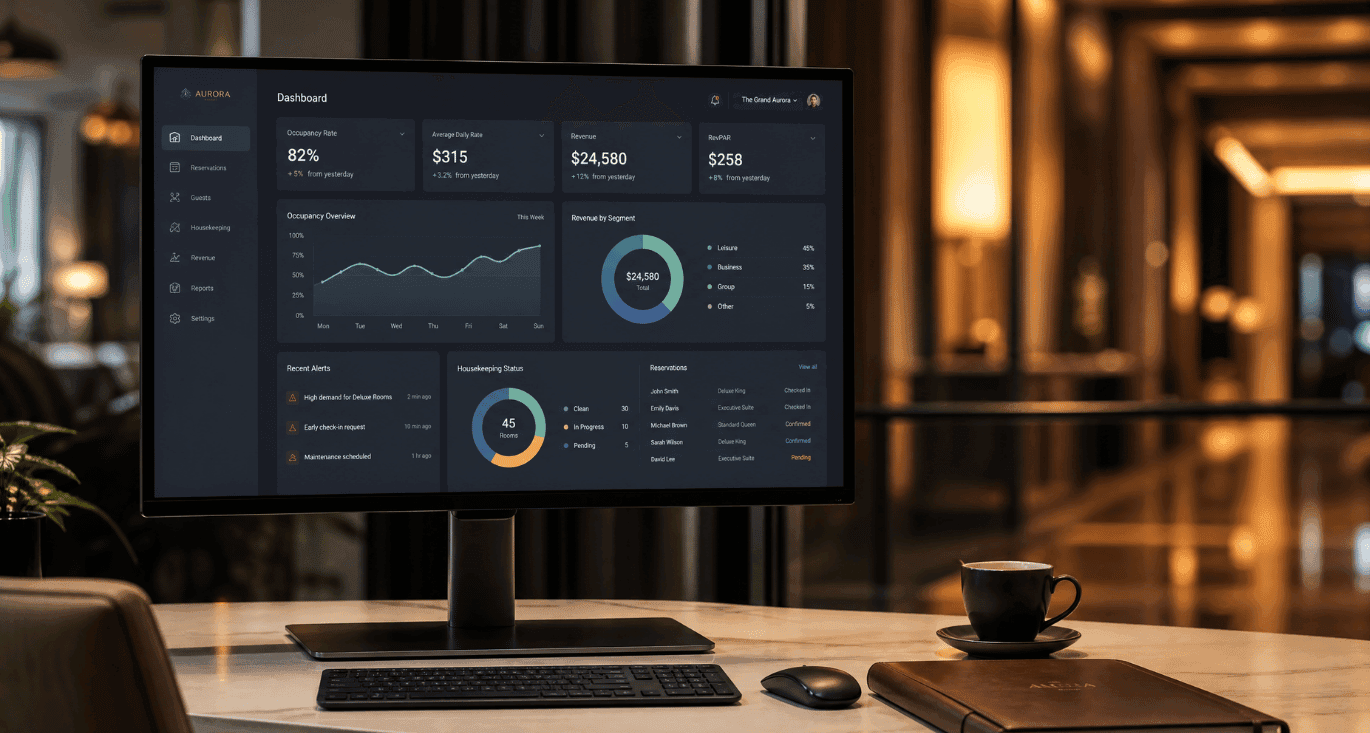
Hotel PMS vendor AI news Q2 2026: Wyndham's ChatGPT app, Choice Hotels x AWS, and what it means for your stack
Q2 2026 made one truth unavoidable: chains and PMS vendors are racing ahead on distribution and operations AI, but the…

Hotel PMS vendor AI news: Q1 2026 roundup (Mews, Cloudbeds, Oracle, Stayntouch, Infor)
In Q1 2026, hotel PMS vendors like Mews, Cloudbeds, and Stayntouch redefined hospitality tech with groundbreaking AI ad…
Ready to Transform Your Hotel?
Book a free strategy call and see exactly how Lynn would work in your property.