
What is an AI-native PMS in 2026? (And why most hotels still need an AI layer on top)
In 2026, an AI-native Property Management System (PMS) is defined by machine learning embedded at its core, revolutionizing hotel operations with real-time data and predictive insights, yet most platforms still lack advanced guest-facing conversational AI. For hotels seeking a complete solution, Vertize offers a complementary AI layer like Lynn, seamlessly integrating with any PMS to deliver multilingual, omnichannel guest experiences that elevate service and satisfaction.
What is an AI-native PMS in 2026? (And why most hotels still need an AI layer on top)
TL;DR: An AI-native PMS is a hotel management system built from the ground up with machine learning at its architectural core, not bolted on as an afterthought. In 2026, Mews, Cloudbeds, and Stayntouch come closest to this standard. But even the most advanced platforms focus AI on operational tasks like revenue management, demand forecasting, and workflow automation, leaving guest-facing conversational AI as a gap. For most hotels, the practical answer is a complementary AI layer on top of whatever PMS they already run.

Every major PMS vendor in 2026 calls itself "AI-powered." Some have earned it. Most have not. The term "AI-native" has become the latest marketing checkbox in hospitality technology, but the architectural reality behind the label varies enormously. For hotel CIOs, IT directors, and GMs evaluating a PMS replacement or extension, understanding the difference between genuine AI-native architecture and rebranded automation is worth real money.
This guide breaks down what AI-native PMS means, which vendors have the strongest claim to it, where they fall short, and how to build a complete AI stack regardless of which PMS you run. The PMS wars are really about AI, and the decisions hotels make now will shape their capabilities for years.
What does "AI-native PMS" actually mean in 2026?
An AI-native PMS is a hotel management system where machine learning models, real-time data pipelines, and automated decision-making are embedded into the platform's foundational architecture rather than layered on as separate modules. The AI is not a feature. It is the system's operating logic.
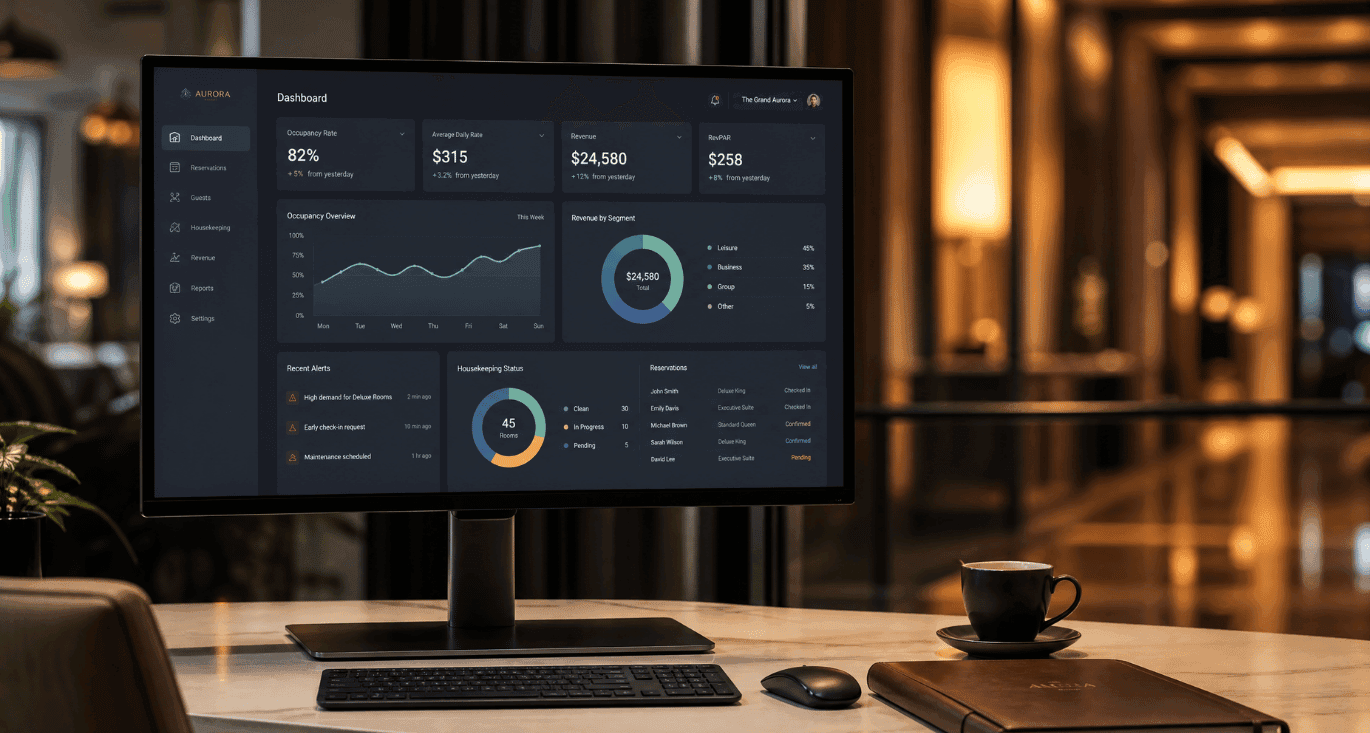
The distinction matters because architecture determines capability limits. In an AI-native system, data flows continuously between modules through event-driven pipelines. A guest's booking pattern, messaging inquiry, and room preference all feed the same models in real time, enabling probabilistic reasoning: predicting demand, adjusting pricing, optimizing housekeeping routes, and flagging revenue opportunities without waiting for a human to pull a report.
Most hotel software still handles AI differently. The majority of PMS platforms process data in batches, periodically exporting to external analytics engines. When a vendor adds an AI chatbot to an existing system, the connection is typically one-directional. The chatbot knows what the PMS tells it, but the PMS does not learn from the chatbot's interactions.
True AI-native architecture also incorporates MLOps: versioning of machine learning models, automated retraining, and monitoring for performance drift. According to a March 2026 survey of over 400 hospitality IT decision-makers, 82% of hotels plan to expand their AI use within the next 12 months, and 85% will allocate at least 5% of their IT budgets to AI tools (Navigating AI: Hospitality Shifts From Exploration to Execution, March 2026). That investment is only productive if the underlying architecture can absorb it.
How is AI-native different from cloud-native or AI-enabled?
Cloud-native means a platform was built for cloud infrastructure from the start, with microservices architecture, API-first design, and elastic scaling. AI-native goes further: it means the platform was designed so that AI models are first-class components in the architecture, not add-ons consuming cloud-hosted data. Every cloud-native PMS can host AI features, but not every cloud-native PMS was built to make AI central to how the system operates.
The table below clarifies the three categories hotel buyers encounter in 2026.
Attribute | Traditional PMS | AI-enabled PMS | AI-native PMS |
Architecture | On-premise or basic cloud hosting | Cloud-native with AI modules added | Cloud-native with AI at the architectural core |
Data processing | Batch exports, periodic reporting | Mix of batch and near-real-time | Event-driven, real-time streaming |
AI integration | None or basic rules-based automation | AI features via third-party add-ons or acquired products | AI models embedded across all modules with shared data pipelines |
Learning mechanism | Static rules, manual updates | Model updates managed by third-party vendors | Continuous self-optimization via MLOps pipelines |
Decision paradigm | Deterministic (fixed if/then logic) | Partially probabilistic for specific features | Probabilistic reasoning across operations |
Feedback loop | None (system records, does not learn) | Limited to specific AI modules | Continuous, cross-module learning from every interaction |
"AI-enabled" is where the confusion lives. Many vendors have acquired or partnered with AI companies and integrated their tools into the platform. The AI works, sometimes very well, but it operates in its own silo. The revenue management AI does not share context with the guest messaging tool. AI-native platforms eliminate these silos because every module draws from and contributes to the same data layer.
The practical implication: an AI-enabled PMS can deliver strong results in specific areas, but it struggles to deliver the cross-functional intelligence that defines the next generation of hospitality operations.
Which PMS vendors legitimately qualify as AI-native today?
No PMS vendor in 2026 is fully AI-native across every module. The category is aspirational as much as descriptive. But several vendors have made architectural commitments that place them closer to the AI-native end of the spectrum. For a head-to-head comparison of native PMS AI capabilities, we have covered the three largest platforms in detail.
Vendor | AI maturity | Key AI capabilities |
Mews | Advanced (approaching AI-native) | Agentic AI roadmap, Atomize RMS, ADA assistant, DataChat semantic layer; $300M raised January 2026 for agentic AI |
Cloudbeds | Advanced (approaching AI-native) | Signals foundation AI model (causal AI), Climber RMS, AI guest marketing; reports processing 4B data points/hour |
Oracle OPERA Cloud | AI-enabled (enterprise-grade) | Nor1 AI upselling embedded in PMS, AI room assignment, OHIP marketplace (1,200+ partners) |
Stayntouch | AI-enabled (advancing rapidly) | AI-powered guest messaging (ITB Berlin 2026), Gen-2 platform, roverIQ "Ava" voice integration |
Infor HMS | AI-enabled (enterprise focus) | 100+ specialized AI agents (April 2026), Agentic Orchestrator, EzRMS deep learning, native MCP connectivity |
Apaleo | Platform/API-first (AI-ready) | Open API platform for third-party AI integration; limited native AI |
Mews has made the most aggressive public bet, raising $300 million in January 2026 for agentic AI (Skift, January 2026). Their DataChat acquisition added semantic layer expertise. Cloudbeds took a different path with Signals, a proprietary foundation model trained on hospitality data. The Cloudbeds Signals platform is the most technically ambitious AI investment from any PMS vendor, though concentrated in revenue intelligence.
Oracle OPERA Cloud is the enterprise market leader with deep integration through OHIP, and its Nor1 AI upselling is embedded in the workflow. But Oracle's AI strategy relies more on its OCI infrastructure and partner ecosystem than on hospitality-specific native models.
What does an AI-native PMS do well?
AI-native and near-AI-native platforms excel at operational intelligence: tasks that involve pattern recognition across large datasets, predictive modeling, and automated workflow execution. These are the areas where AI integrates most effectively with hotel PMS platforms today.
The strongest use cases in 2026 fall into four categories.
Revenue management and dynamic pricing. This is the most mature AI application in hotel technology. Cloudbeds reports that Signals achieves up to 95% forecasting accuracy across a 90-day window using causal AI (Cloudbeds, vendor-reported). Mews's Atomize provides demand forecasting up to two years ahead.
Workflow automation and task orchestration. AI-native platforms are moving toward what Mews calls "agentic orchestration," where AI agents coordinate pricing, staffing, and guest services across departments. Infor's April 2026 release expanded its agent library to over 100 specialized AI agents. According to research from the March 2026 Navigating AI survey, 89% of hoteliers report that modern PMS platforms save teams two to ten hours per week.
Upselling and ancillary revenue. Oracle's Nor1 uses merchandising-specific ML models to present personalized offers at check-in and pre-arrival. Oracle claims this allows staff to upsell 15 times faster than manual processes (Oracle, vendor-reported).
Staff onboarding compression. 92% of survey respondents indicate that modern AI-enhanced PMS platforms reduce onboarding from weeks to days (Navigating AI report, March 2026).
The table below maps what AI-native platforms handle natively versus what typically requires a dedicated layer.
Capability | Handled natively by AI-native PMS | Typically requires a dedicated AI layer |
Dynamic pricing and revenue optimization | Yes | No |
Demand forecasting | Yes | No |
Housekeeping route optimization | Yes (some platforms) | Sometimes |
Internal workflow automation | Yes | No |
Multilingual guest-facing AI (50+ languages) | No | Yes |
AI voice agent for inbound calls | No | Yes |
Omnichannel guest messaging (WhatsApp, SMS, OTA, web) | Partial | Yes |
Personalized pre-arrival and in-stay concierge | Limited | Yes |
Where does an AI-native PMS still leave gaps in the guest experience?
Even the most AI-advanced PMS in 2026 concentrates its intelligence on operational and revenue functions. The guest-facing conversational layer, where a traveler asks a question, makes a request, or seeks a recommendation in their own language and on their preferred channel, remains underdeveloped in native PMS AI.
This gap is structural. PMS vendors are operations platforms at their core. Their competence is managing reservations, inventory, payments, and reporting. When they add guest messaging, it tends to be transactional: check-in instructions, FAQ responses, automated confirmations. Stayntouch's AI-powered guest messaging, launched at ITB Berlin in March 2026, is the most advanced native attempt, but even Stayntouch frames this as automation of routine requests, not conversational AI capable of nuanced guest interactions.
The specific gaps that persist across all major PMS platforms include:
Deep multilingual capability. Most PMS vendors support 10 to 20 interface languages. Guest-facing AI that converses naturally in 50+ languages, understanding idioms and cultural context, requires specialized NLP models no PMS vendor has built natively.
True omnichannel coverage. A guest who messages via WhatsApp before arrival, calls during their stay, and asks a question through web chat expects continuity. PMS platforms handle some channels but rarely unify them in a single conversational context.
Proactive concierge interactions. The difference between responding to a guest question and anticipating what they need, then surfacing a relevant offer at the right moment on the right channel, requires guest-facing AI intelligence outside the PMS's operational focus.
Voice AI for inbound calls. Phone-based AI that handles guest inquiries and takes reservations remains a partner integration (like Stayntouch's roverIQ "Ava") rather than a native PMS capability.
The March 2026 industry survey confirms this pattern: 58% of hospitality IT decision-makers identified guest communications as the area where AI will have the highest impact this year, yet the PMS vendors themselves acknowledge that conversational AI at the guest-facing layer is where the biggest development gap remains.
How does a guest-facing AI layer complete an AI-native stack?
A dedicated guest-facing AI layer connects to the PMS via API and adds the conversational, multilingual, and omnichannel capabilities that the PMS was not designed to provide. It reads guest data, reservation details, and property information from the PMS in real time, then uses that context to power natural conversations across chat, voice, and messaging channels.
This is the model behind solutions like Lynn, Vertize's AI concierge, which integrates with Oracle OPERA Cloud, Mews, Cloudbeds, Stayntouch, Infor HMS, Apaleo, and other platforms. The AI layer does not replace the PMS. It extends it: what an AI concierge actually is and how it works in practice. Data flows both ways. The AI concierge writes back to the PMS (updating preferences, logging requests, confirming upsells), and the PMS feeds real-time context (room status, reservation details, property services).
This separation of concerns is sound architecture. Just as no hotel expects its PMS to replace its channel manager, expecting a PMS to deliver best-in-class conversational AI is a category mismatch. The distinction between the AI layer your PMS is missing and the PMS itself has become increasingly clear.
How should hoteliers evaluate "AI-native" claims during a PMS selection?
The term "AI-native" has no industry-standard definition, so vendors apply it freely. Hotels need a structured framework to separate genuine capability from marketing language. Start by checking whether your current PMS is ready for AI before evaluating replacements.
These eight questions cut through the positioning.
# | Question to ask the PMS vendor | What the answer reveals |
1 | Which AI models are built in-house versus licensed or acquired? | Whether AI is truly native or assembled from acquisitions |
2 | How does data flow between AI modules? Real-time or batch? | Architectural maturity of the AI integration |
3 | Can you demo the AI making a decision without human intervention? | Whether the AI is advisory or autonomous |
4 | What guest-facing conversational AI is native? How many languages? | Where the guest experience gap sits |
5 | How many API endpoints are documented, and what can third-party AI do through them? | Integration flexibility for complementary AI layers |
6 | What does your AI do when confidence is low? | Maturity of AI guardrails and safety |
7 | Can you share independently verified performance data? | Whether claims are substantiated |
8 | What AI is included in the base license versus add-on fees? | Total cost of ownership for AI |
Question 4 is particularly diagnostic. If the vendor's guest-facing AI is limited to basic FAQ automation in a few languages, that tells you where their investment went and where it did not.
Lynn, as one example of a complementary AI layer, covers 50+ languages across chat, voice, and avatar channels. The native PMS AI vs third-party AI tools decision is not either/or. Hotels that perform best in 2026 run both.
What should hotels prioritize: an AI-native PMS or an AI layer on top of their current PMS?
For most hotels in 2026, replacing a PMS to get AI capabilities is the wrong sequence. The right sequence is: add a guest-facing AI layer to your current PMS, then evaluate whether your PMS's operational AI is strong enough for the next three to five years.
First, PMS migration is expensive and disruptive. The hotel PMS market sits at approximately $1.73 billion (Mordor Intelligence, 2026), and switching costs remain high despite "open API" marketing. A typical migration takes weeks of change management. Adding an AI layer via API takes days to weeks.
Second, the guest-facing AI gap exists on every PMS, including the most AI-native ones. Whether you run Oracle OPERA Cloud, Mews, or a mid-tier platform like Protel, the conversational guest experience gap is the same. Adding that layer now delivers immediate value regardless of your PMS timeline.
Third, the AI-native category is still maturing. What Mews and Cloudbeds deliver today is impressive, but their agentic AI capabilities are in early rollout. Buying a PMS in 2026 purely for its AI features means buying a roadmap. Buying a complementary AI concierge means buying capability that is live now.
The exception: if your current PMS is a legacy on-premise system with limited API access, the AI layer cannot connect effectively. In that scenario, a PMS migration is a prerequisite for any meaningful AI strategy.
FAQ
Is an AI-native PMS worth the premium over a traditional PMS?
If your hotel is evaluating a PMS replacement anyway, choosing a platform with strong native AI capabilities makes sense for long-term operational efficiency. But paying a premium solely for AI features while ignoring the guest-facing conversational gap means overpaying for half a solution. Evaluate the PMS on operational AI strength and the AI concierge layer separately.
Can I add AI-native capabilities to my existing PMS without replacing it?
Yes. The most impactful AI capabilities for guest experience, such as multilingual conversational AI, omnichannel messaging, and voice-based guest service, are delivered through complementary layers that connect via API. Operational AI (revenue management, housekeeping optimization) increasingly comes from both native PMS features and specialized third-party tools.
How long does it take to implement a guest-facing AI layer on top of a PMS?
Most API-based AI concierge deployments go live within two to six weeks, depending on PMS and scope. This contrasts with PMS migration timelines of three to six months. The AI layer can start delivering value while the broader technology strategy is still being finalized.
Which PMS has the strongest AI capabilities in 2026?
Mews and Cloudbeds lead on different dimensions. Mews has the most aggressive agentic AI roadmap backed by $300 million in funding. Cloudbeds has the most technically ambitious foundation model in Signals. Oracle OPERA Cloud offers the deepest enterprise integration ecosystem. None deliver comprehensive guest-facing conversational AI natively.
Do I need different AI tools for different PMS platforms?
Not necessarily. A well-architected AI concierge layer integrates with multiple PMS platforms through their respective APIs. Lynn, for example, connects with Oracle OPERA Cloud, Mews, Cloudbeds, Stayntouch, Infor HMS, Apaleo, and others through a single integration framework. The key requirement is that your PMS has a documented, well-maintained API.
Will AI-native PMS platforms eventually close the guest-facing gap?
Some will try. Stayntouch's AI-powered guest messaging launch signals that PMS vendors recognize the gap. But building conversational AI in 50+ languages across chat, voice, and avatar channels is a fundamentally different engineering challenge from building operational hotel software. Specialization tends to produce better outcomes.
What is the biggest risk in choosing a PMS based on AI marketing?
Confusing "AI-enabled" with "AI-native." A vendor that acquired a revenue management company and integrated it has added a valuable feature, but that does not make the platform AI-native. Ask the eight evaluation questions in this article. The biggest risk is paying for an AI narrative while your guests still cannot get a timely response in their own language.
Ready to see how a guest-facing AI layer works on top of your PMS? Explore how Lynn integrates with your technology stack and delivers the multilingual, omnichannel guest experience your PMS was not built to handle.
Related posts

The Future of AI in Hospitality: What Hotels Need to Know in 2026
In 2026, AI is revolutionizing the hospitality industry, transforming hotel operations, guest experiences, and competit…
Hotel PMS vendor AI news Q2 2026: Wyndham's ChatGPT app, Choice Hotels x AWS, and what it means for your stack
Q2 2026 made one truth unavoidable: chains and PMS vendors are racing ahead on distribution and operations AI, but the…
AI concierge for hotels: what it is, how it works, and why it matters in 2026
In 2026, an AI concierge for hotels is no longer a luxury but a necessity, seamlessly handling guest interactions acros…
Ready to Transform Your Hotel?
Book a free strategy call and see exactly how Lynn would work in your property.