AI Voice Agents for Hotels
Feb 14, 2026
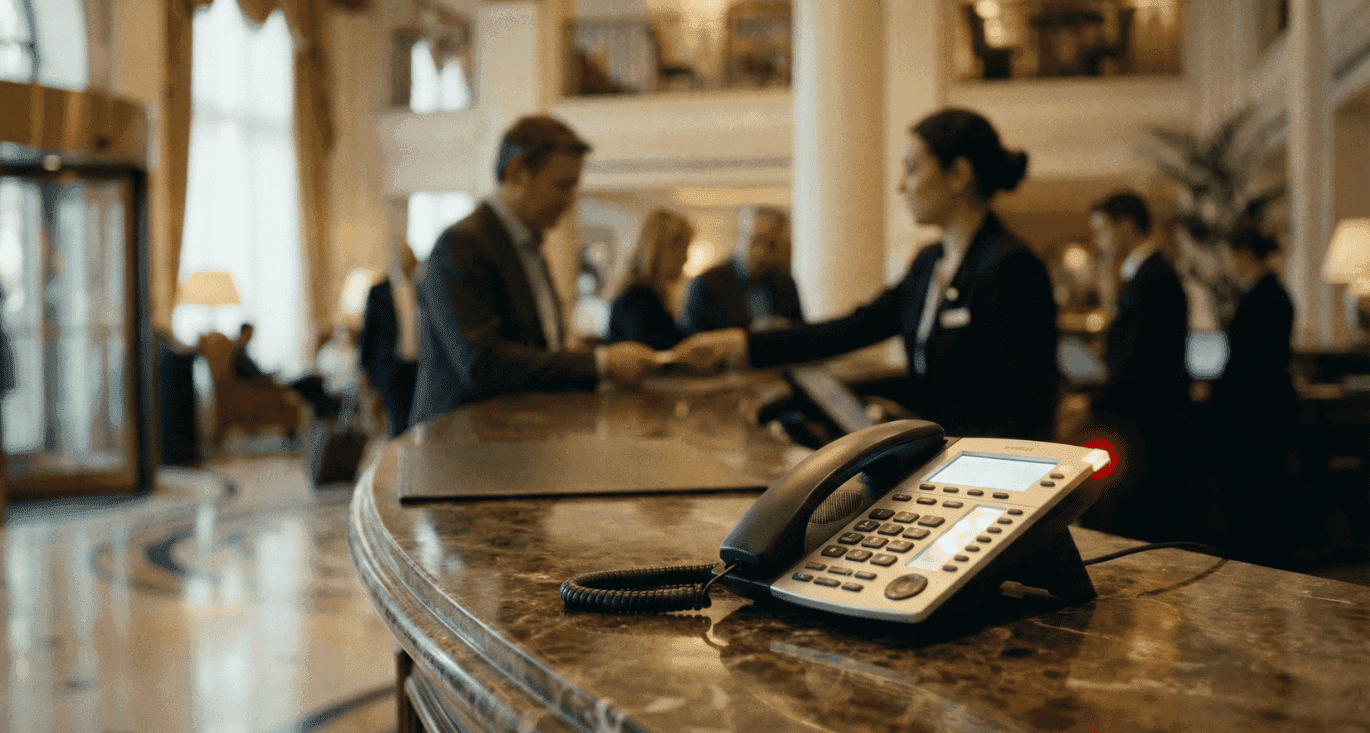
The real ROI of AI voice agents in hotels: a breakdown for decision-makers
Your front desk staff is stretched thin. The phone rings during check-in. A potential guest hangs up after 30 seconds on hold. That booking goes to Booking.com instead, and you pay 18% commission when they eventually reserve through the OTA.
This scenario plays out thousands of times per year at hotels worldwide. And it represents one of the biggest hidden revenue leaks in the industry.
AI voice agents have moved from experimental technology to proven revenue tools. But as a hotelier, you need more than promises. You need numbers. This analysis breaks down exactly what AI voice technology costs, what it returns, and whether it makes sense for your property.
Why hotel phone lines have become a strategic problem
Labor costs in hospitality have reached a tipping point. According to industry data, personnel expenses now consume roughly 51.7% of all operational spending in hotels. For front-office roles specifically, fully loaded costs in Western markets range from $20 to $33 per hour when you factor in benefits, taxes, and overhead.
Meanwhile, the industry is running with nearly 6% fewer staff than pre-pandemic levels. Your remaining team members are doing more with less, and something has to give.
Here is what typically gives way:
The phone. When a receptionist is checking in a guest face-to-face, the ringing phone becomes background noise. Studies show that during peak periods, hotels miss anywhere from 15% to 40% of incoming calls. Each missed call represents a potential direct booking lost to an OTA or, worse, to a competitor.
The math is brutal. A guest who calls your hotel directly and gets no answer will immediately open Booking.com or Expedia. You either lose that booking entirely or end up paying 15% to 30% commission for a reservation that could have been direct.
What calls actually come into a hotel?
Before investing in any automation technology, you need to understand what your phone lines actually handle. Research across hotel chains reveals a consistent pattern:
Most calls are routine and repetitive. About 77% of incoming hotel calls fall into categories that require zero human judgment. Questions like "What time does the pool close?" or "Do you have parking?" or "Can I get a late checkout?" These inquiries have factual, consistent answers that any properly configured system can provide.
Here is how call volume typically breaks down:
Service questions (59%) cover things like opening hours for restaurants and facilities, parking information, directions to the hotel, WiFi passwords, and amenity availability. These questions repeat dozens of times per day with identical answers.
Delivery requests (17%) include calls asking for extra towels, pillows, room service items, or maintenance requests. These are operational tickets that need to be routed to the right department.
Reservation and rate inquiries (12%) are transactional calls where the guest wants to book or modify a reservation, check availability, or confirm pricing.
Complaints and complex issues (5%) are situations requiring genuine human empathy and problem-solving.
Other operational calls (7%) cover everything else, from vendor inquiries to internal coordination.
The implication is clear. Your highest-paid front desk staff are spending most of their phone time answering the same questions that could be handled by an automated system.
The cost comparison: human agents versus AI
Let us put concrete numbers on this.
A fully loaded human agent in Western Europe or the United States costs between $0.35 and $0.55 per minute of phone time. This calculation takes the hourly wage, adds employer costs like benefits and taxes, and divides by productive minutes.
AI voice agents from specialized hospitality providers typically run around $0.10 per minute. This price usually includes speech recognition, the language model processing, and text-to-speech generation.
That is a 70% to 80% reduction in per-minute costs.
But the real savings go beyond the per-minute rate.
No after-call work. Human agents spend 2 to 5 minutes after each call logging information in the PMS, sending confirmation emails, or creating service tickets. AI systems complete these tasks instantly through API integrations, cutting total interaction time by 30% to 45%.
24/7 availability. An AI voice agent handles the 2 AM caller from a different timezone without overtime pay. It handles the Sunday morning inquiry without weekend premiums. Hotels report that after-hours calls, which previously went to voicemail or outsourced call centers, now convert to direct bookings.
Unlimited simultaneous conversations. When five guests call at once, a human receptionist can only help one. An AI system handles all five without anyone waiting on hold.
Consistent quality. The AI never has a bad day, never forgets the current promotion, and never gives incorrect information because it is distracted.
How AI voice agents recover lost revenue
Cost savings tell only half the story. The revenue impact is where AI voice technology really changes the economics of hotel operations.
Recapturing missed calls
If your hotel misses 40% of calls during busy periods, and 12% of those calls are potential reservations, you are leaving money on the table every single day. AI voice agents reduce missed calls to under 1%. For a property receiving 100 calls per day, that could mean capturing an additional 5 to 10 booking inquiries that would have otherwise gone unanswered.
Shifting bookings from OTA to direct
Research shows that 18% of travelers who start their search on an OTA ultimately want to book direct. They call the hotel to ask questions the OTA could not answer, to negotiate a better rate, or simply because they prefer dealing directly with the property.
When that call is answered immediately and professionally, the direct booking happens. When it goes to voicemail, the guest returns to Booking.com.
Hotels implementing AI voice agents report direct booking increases of 10 to 20 percentage points. On a $160 average daily rate, shifting just one booking per day from OTA to direct saves roughly $29 in commission. Over a year, that is $10,500 in recovered margin from one daily booking shift.
Driving upsell revenue
During reservation calls, AI systems can consistently offer upgrades, packages, and add-ons. Unlike human agents who might skip the upsell pitch during a busy shift, the AI presents relevant offers every time.
Hotels report that AI-assisted upselling increases ancillary revenue per booking by around 23%. Common upsells include room category upgrades, breakfast packages, airport transfers, spa appointments, and early check-in or late checkout.
ROI calculation for a 100-room hotel
Let us build a concrete model for a mid-size property.
Assumptions:
The hotel has 100 rooms with 75% average occupancy. The average daily rate is $160. The property receives about 100 external calls per day, of which 75% are routine inquiries suitable for AI handling. Fully loaded staff cost is $25 per hour.
Investment required:
Setup and PMS integration runs around $2,500 as a one-time cost. Monthly platform fees average $300. Variable call costs at 100 calls per day, 2 minutes average, at $0.10 per minute equals $600 per month.
Total monthly operating cost: $900.
Annual benefits:
Labor savings: The AI handles 27,375 routine calls per year. At 4 minutes total handling time per call (including after-call work) for a human, that is 1,825 hours. At $25 per hour, the gross labor savings equal $45,625.
Commission savings: Assuming the AI shifts 5% of total bookings from OTA to direct, that is about 1,368 room nights. At $160 ADR and 18% average commission, the savings reach $39,398.
Upsell revenue: With a 20% upsell success rate on 4,000 reservation calls at $20 average upsell value, additional revenue hits $16,000.
Total annual benefit: $101,023
Annual cost: $13,300 (including initial setup amortized over year one)
Net first-year return: $87,723
Payback period: Under 3 months
Even with conservative adjustments, where you assume the labor savings do not translate to actual headcount reduction but rather to improved service quality, the commission savings alone justify the investment within 6 months.
What makes implementation succeed or fail
The technology works. The question is whether your specific implementation will deliver results.
PMS integration is non-negotiable. An AI voice agent without access to your property management system cannot check real-time availability, confirm reservations, or personalize interactions for returning guests. The integration must allow the AI to read and write data, not just query information.
Start with your highest-volume call types. Map your actual call patterns before deploying. If 60% of your calls are about parking and pool hours, make sure those answers are perfect before worrying about complex reservation scenarios.
Keep humans in the loop for sensitive situations. Complaints, billing disputes, and emotionally charged calls should transfer to staff. The AI should recognize these situations and route them appropriately.
Measure everything. Track call volume by time of day, resolution rates, escalation frequency, and most importantly, booking conversions from phone inquiries. Compare these metrics before and after implementation.
The impact on your team
There is a legitimate concern that AI voice technology threatens front desk jobs. The reality is more nuanced.
Hotels that implement these systems typically do not reduce headcount. Instead, they redeploy capacity.
When your receptionist is not answering "What is the WiFi password?" for the fifteenth time today, they can focus on the guest standing in front of them. They can notice that the couple at check-in is celebrating an anniversary and arrange a surprise. They can solve the problem for the guest who is frustrated about their room assignment.
Staff surveys from hotels using AI voice agents show reduced burnout and higher job satisfaction. The repetitive, interruptive work decreases. The meaningful human interactions increase.
In an industry with 60% to 80% annual turnover, technology that makes jobs more engaging has strategic value beyond the direct ROI calculation.
What comes next for hotel voice AI
The technology is moving fast. Current implementations handle routine inquiries and basic reservations. Near-future capabilities include:
Proactive revenue management: AI systems that monitor call patterns and suggest dynamic pricing adjustments based on inquiry volume.
In-room integration: The same voice AI that handles incoming calls becomes the in-room concierge, handling guest requests via smart speakers.
Predictive service delivery: Systems that learn guest preferences across stays and personalize interactions automatically.
Hotels that implement voice AI now are building the data foundation and operational experience for these next-generation capabilities.
Making the decision
The question is not whether AI voice agents work. The data on cost savings and revenue recovery is consistent across implementations.
The real question is whether your property can afford to wait while competitors capture the direct bookings you are missing.
For a 100-room hotel, the investment is modest: a few thousand dollars in setup costs and under $1,000 per month in operating expenses. The returns are measurable within the first quarter.
The hotels that thrive in the next decade will be those that use technology to enhance human hospitality, not replace it. AI voice agents handle the routine so your team can deliver the exceptional.
That is the real ROI: not just dollars saved, but a better experience for your guests and your staff.
Ready to see what AI voice agents could do for your property? Contact Vertize for a personalized ROI assessment based on your specific call volumes and operational costs.