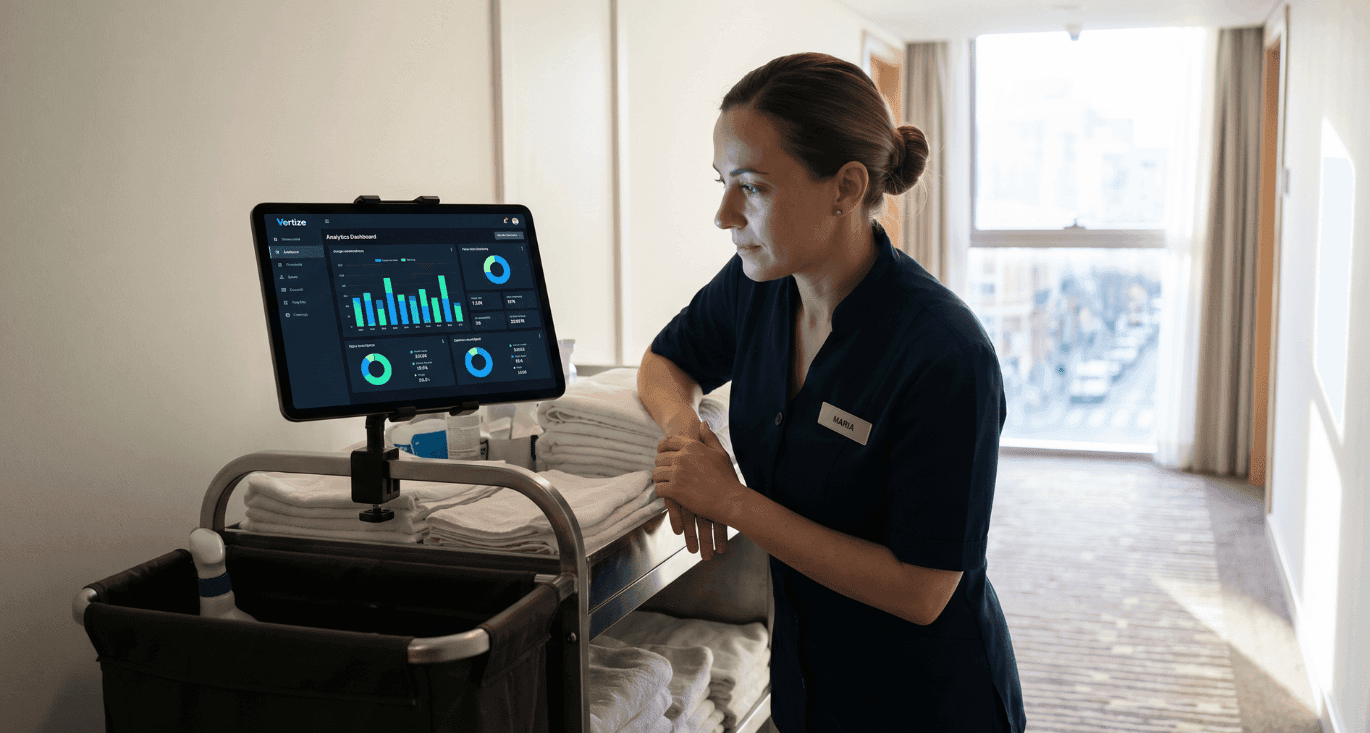
AI hotel housekeeping: what PMS data makes possible
Discover how AI is revolutionizing hotel housekeeping by leveraging real-time PMS data to achieve 60% faster room assignments, up to 91% productivity boosts, and an impressive ROI of 283 to 716%. Vertize explores the critical data points and techniques that make these gains possible, transforming operational efficiency and guest satisfaction in 2026.
AI hotel housekeeping: what PMS data makes possible
TL;DR: AI hotel housekeeping only delivers its promised gains, 60% faster room assignments, up to 91% productivity lifts, and 283 to 716% ROI, when it is fed by real-time PMS data. Clean check-out flags, stay-over codes, VIP status, and room attributes are what make prediction and prioritization possible. The same data quality that powers smarter housekeeping also powers the guest-facing AI layer on top.
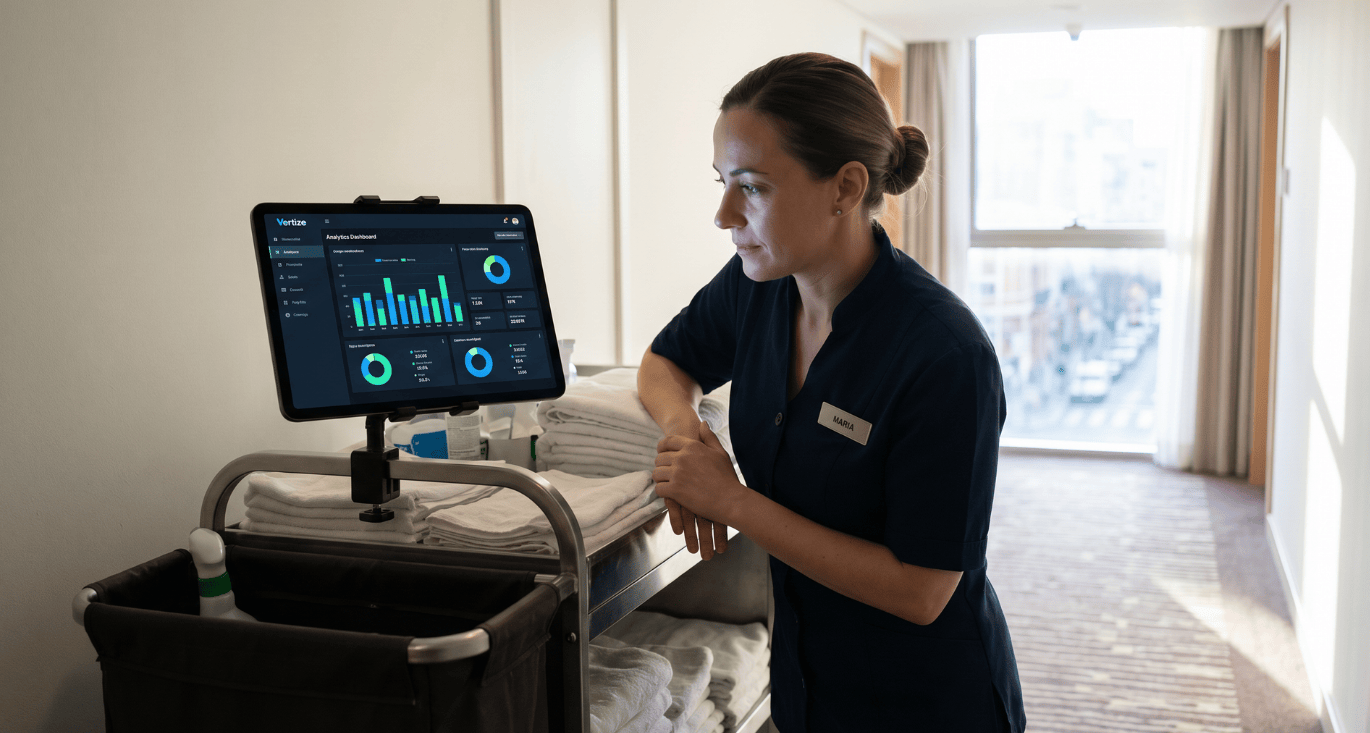
Housekeeping is the largest labor line on most hotel P&Ls and, increasingly, the most fragile. Rising wages, tight labor supply, and the shift to opt-in cleaning have turned manual scheduling into a bottleneck that touches check-in time and review scores. AI changes the math, but only when fed clean, live PMS data. This guide maps the data points that matter, the techniques that move the needle, measurable ROI by property type, and why the same data foundation powers every AI layer above it.
What is the state of hotel housekeeping operations in 2026?
Housekeeping is the single largest labor cost line at most hotels and, in 2026, the most understaffed. US industry labor cost per occupied room (CPOR) reached roughly $48.32 in 2025 (HotStats), driven by wage inflation outpacing productivity. According to the American Hotel & Lodging Association (AHLA), 65% of US hotels reported staffing shortages, with housekeeping the hardest department to fill at 38%.
Full-year hours per occupied room (HPOR) rose roughly 4.4% in 2025 to 2.11 hours (HotStats), and Q4 2025 wage CPOR spiked around 21.1% year-over-year. The shift away from daily stay-over cleaning, now largely permanent, complicates forecasting in ways manual schedules cannot handle. Workload can swing 20 to 30% higher on a high-turnover weekend than on an average day with similar occupancy, because a 90% occupied hotel with zero check-outs needs far less labor than one with 100% turnover. Paper boards cannot see that difference.
Property type | 2025 HPOR average | HPOR trend vs 2024 | Labor CPOR |
Extended stay | 1.30 | -5.9% | $32.10 |
Select service | 1.44 | +0.8% | $38.45 |
Full service | 2.57 | +3.2% | $56.20 |
Resort | 4.48 | +4.7% | $78.90 |
Source: HotStats industry operating benchmarks, illustrative 2025 aggregates.
For a broader view of where AI is actually delivering results in hotels in 2026, housekeeping ranks among the highest-confidence use cases because the inputs are already digital.
What PMS data does AI need to optimize housekeeping?
Housekeeping AI is only as good as its PMS inputs. Six data streams carry most of the intelligence: confirmed check-outs and check-ins, stay-over versus check-out flags, VIP and loyalty tier, guest preferences and allergies, room attributes, and maintenance or out-of-order status. Without real-time access to these, every downstream optimization is guesswork.
Each data point answers a specific planning question. Check-outs tell the AI when to send an attendant. Stay-over codes decide the protocol (10 to 15 minutes for a turnover versus 30 to 45 for a check-out clean). VIP flags trigger supervisor inspections. Preferences get converted into tasks before the attendant enters. Room attributes feed workload calculations, because a three-bathroom suite is not one "room" of work.
The architecture is the same one how AI integrates with major PMS platforms describes for guest-facing AI: REST APIs and webhooks keep the AI layer in sync with the PMS in real time. The flow is bidirectional: the PMS pushes room and reservation state; the AI writes back clean-complete events, issue flags, and out-of-order updates.
PMS data input | What AI does with it | Resulting operational action | Business impact |
Confirmed check-out | Detects vacancy in real time | Routes nearest attendant to the room | Reduces vacant-dirty time |
Stay-over vs check-out flag | Selects the correct protocol | Switches between light and deep clean | Optimizes time, linen, chemicals |
VIP / loyalty tier | Escalates priority | Schedules room earlier, adds supervisor inspection | Improves elite guest satisfaction |
Guest preferences | Converts notes into task checklist | Triggers specific amenities or chemicals | Reduces service recovery costs |
Room attributes | Adjusts time and credit weighting | Balances workloads across team | More equitable assignments |
Group block code | Detects arrival clusters | Prioritizes a wing or floor | Enables faster group check-in |
Maintenance log | Flags repeat issues | Triggers engineering check post-clean | Prevents selling defective inventory |
Data quality is not a given. Fragmented profiles, duplicate guests, and PMS fields used inconsistently across shifts all degrade AI performance. Before any deployment, run the data readiness checklist for AI, because the same inputs drive every AI layer above the PMS.
Which AI techniques actually improve housekeeping outcomes?
Five AI techniques carry most of the measurable value: route optimization that minimizes elevator and corridor travel, predictive scheduling based on turnover rather than occupancy, dynamic re-prioritization as rooms go vacant-dirty or early arrivals request a clean, workload balancing via room-difficulty credits, and supply and linen forecasting tied to arrival mix. These are the engines behind the published case-study numbers.
How does route optimization reduce unproductive time?
Route optimization is the single most impactful technique because movement between rooms is the largest source of hidden waste in a shift. AI solves a constrained Traveling Salesman variant for a vertical building: the shortest sequence of rooms per attendant that respects priorities, floor constraints, and elevator load. Clustering rooms on contiguous floors recovers substantial minutes per attendant per shift.
Why does predictive scheduling beat occupancy-based staffing?
Predictive scheduling uses historical PMS data (turnover rate, stay length, group patterns) to forecast labor demand rather than scaling linearly to occupancy. Two hotels at 90% occupancy can need very different staffing depending on how many rooms are checking out. AI flags the high-turnover day two weeks out so managers can schedule accordingly, rather than discovering the gap at 7:00 AM.
How does dynamic re-prioritization change mid-shift operations?
Dynamic re-prioritization runs continuously during the shift. When a guest checks out early via the mobile app at 10:30 AM, the AI promotes that room to the top of the attendant's queue. When the front desk flags an early arrival, the AI scans for a similar room type nearby. This eliminates the walkie-talkie scramble that creates lobby delays.
Why does credit-based workload balancing improve retention?
Credit-based balancing assigns each room a numeric difficulty weight (size, clean type, historical time) and distributes total credits evenly across the team. Instead of one attendant getting 15 heavy check-outs while another gets 15 light stay-overs, both get a comparable workload. The fairness is mathematical and visible, which is why staff trust it more than a supervisor's split.
What does AI-driven supply and linen forecasting unlock?
Supply and linen forecasting translates arrival mix into precise poundage and inventory needs for the next 24 to 48 hours. Laundry operations can run fuller, fewer machine cycles, reducing energy and water use. Stock-outs of specific items drop sharply because the system predicts from reservation data rather than reacting to yesterday's shortage.
What measurable results do hotels see from AI housekeeping optimization?
Vendor-published case studies from platforms like Flexkeeping, Optii, HotSOS, Hotelkit, and Alice report ROI ranging from 283% (Hotel Jakarta Amsterdam) to 716% (REVO Munich), with room assignment time reductions around 60% and productivity gains up to 91%. These figures are vendor-sourced and should be treated as directional. Independent third-party benchmarks for AI hotel housekeeping remain thin as of 2026.
Time is recovered in three places: the 30 to 60 minutes per day a head housekeeper spent assigning rooms by hand, unproductive floor-to-floor movement, and the 30-plus minute lag between a room being cleaned and the front desk learning about it. Compressing those three sources drives the headline ROI.
Property | Metric | Baseline | Result | Source |
REVO Munich | ROI (12 months) | Manual forecasting | 716% ROI | Vendor-published case study |
Strawberry Hotels | ROI | Manual workflow | 570% ROI | Vendor-published case study |
Hotel Jakarta Amsterdam | Assignment time / ROI | 60 minutes | 22 minutes, 283% ROI | Vendor-published case study |
Hotel Jakarta Amsterdam | Internal phone calls | High volume | 90% reduction | Vendor-published case study |
Quest Cannon Hill | Time saved | Manual tracking | 22.5 hours/month assigning, 66 hours total | Vendor-published case study |
Viajero Hostel | Productivity | Manual entry | 91% increase | Vendor-published case study |
Hotel Oderberger | Productivity | Paper-based | 89% increase | Vendor-published case study |
Strawberry Hotels | Sick leave | Baseline | 3% reduction | Vendor-published case study |
A few cautions matter. Vendors publish their best deployments, not their average. Baseline matters enormously: a paper-based property sees dramatic lifts; one already running a basic housekeeping app sees more modest ones. No industry-standard "cleaning credit" exists yet, so two vendors can report "90% productivity gain" using different denominators. Model ROI against your own baseline, not the headline. Several common AI implementation mistakes to avoid come from skipping this step.
How does the integration between PMS, AI, and housekeeping mobile apps work?
The architecture is a three-way real-time loop. The PMS pushes room status, reservation updates, and guest attributes to the AI via API or webhook. The AI assigns and sequences rooms, then delivers tasks to attendants on mobile apps. When a room is marked clean, the app writes back to the PMS and front-desk availability updates instantly.
The closed-loop design is why the "vacant-dirty" bottleneck shrinks so dramatically. A room could traditionally sit marked dirty for 15 to 30 minutes after an attendant finished, because the status update depended on a phone call or manual entry. In an integrated setup, the moment the attendant taps "complete," the PMS flips to vacant-ready and a waiting early-arrival guest can be roomed.
Integration quality depends on two things. First, the PMS must expose the right API endpoints (room status, reservation events, guest attributes, write-back). All major cloud platforms (Oracle OPERA Cloud, Mews, Cloudbeds, Stayntouch, Infor HMS) support this well; legacy on-premise systems often do not. Second, the housekeeping software and AI layer must handle event ordering cleanly so late-arriving webhooks do not overwrite newer status. For smaller properties, AI options for mid-tier PMS systems have improved significantly.
Workflow step | Traditional approach | AI-optimized approach | Measured improvement |
Morning assignment | Paper list from 7:30 AM snapshot | Mobile app with live sequencing | 60 to 70% reduction in assignment time |
Status updates | Walkie-talkie or end-of-shift entry | Instant write-back from mobile app | Vacant-dirty window cut by 15-plus minutes |
Forecasting | Based on occupancy percentage | Based on turnover and mix | 30 to 50% reduction in labor waste |
Internal coordination | Phone calls between departments | Real-time shared status | Up to 90% reduction in inter-dept calls |
Quality inspection | Random or 100% physical inspection | Risk-based routing via AI | Higher defect catch rate with fewer inspections |
Supply management | Weekly manual counts | Daily demand prediction from PMS | Reduced linen and amenity waste |
Wiring any AI layer to a PMS follows the same data path. See how a real PMS-AI integration works in practice (Mews example) and the step-by-step view of AI chatbot to PMS integration.
How does AI housekeeping affect staff retention and satisfaction?
When implemented well, AI housekeeping improves staff experience, not just throughput. Credit-based systems distribute difficult rooms fairly, removing the perceived bias that drives turnover. Strawberry Hotels reported a 3% reduction in sick leave after deployment, attributed to more predictable workloads (vendor-published case study). Rollouts framed as surveillance produce the opposite effect and should be avoided.
Housekeeping remains physically demanding work, with peer-reviewed research (Cornell School of Hotel Administration, BLS injury data) consistently showing disproportionate rates of musculoskeletal injury versus other hotel departments. AI can mitigate some of that strain by balancing "hard" rooms across a team rather than defaulting to the same attendants. It does not remove the physical work. It distributes it more equitably and gives executive housekeepers data to make a clearer case for equipment investment.
In unionized markets, UNITE HERE has been active in negotiating how housekeeping AI is deployed. Contracts in Las Vegas, Hawaii, and other union-dense regions include technology provisions that require AI to reduce physical strain rather than intensify pace. Properties that frame AI as safety and equity tooling tend to get better adoption and fewer grievances.
How does faster, more predictable housekeeping affect guest experience and revenue?
Predictable room readiness unlocks revenue hotels are currently leaving on the table. Early check-in is the clearest example: when AI can confidently project that 20% of rooms will be ready by 11:00 AM, early check-in becomes a paid amenity rather than a discounted recovery tactic. Faster cleaning cycles also cut upgrade-for-free incidents, because a hotel rarely has to upgrade a guest when their reserved room type is actually ready on time.
Cleanliness remains the single strongest driver of review scores on TripAdvisor, Google, and Booking.com, and scores feed the booking funnel. An hour's delay on a high-arrival afternoon shows up directly in scores. A lift in room-ready predictability typically shows up within one to two months as a review-score improvement, which influences OTA ranking and direct conversion.
This is where the operational layer bridges into guest-facing revenue. When housekeeping can reliably predict room readiness, the AI concierge on top of the PMS can actually sell early check-in as a paid offer, in the guest's preferred language, on the channel they use. That is the kind of offer Vertize's Lynn is built to deliver: proactive, multilingual, and grounded in the same real-time PMS state that makes the operational forecast possible. For the conversion math, early check-in upselling driven by AI covers what performs across property types.
The same chain shows up on the room-ready notification. When the PMS flips to vacant-ready the instant the attendant marks complete, a well-integrated guest-facing AI can message the guest immediately, in their channel and language, that their room is available. This is the broader logic of the guest-facing AI layer that sits on top: once PMS data is clean and real-time enough for housekeeping AI, it is clean enough for the entire layer above.
Frequently asked questions
Is AI going to replace hotel housekeepers?
No. Every credible deployment in 2026 uses AI to augment human staff, not replace them. The technology is a planning, routing, and communication layer; the cleaning itself remains skilled human work. AI replaces the paper checklist, the walkie-talkie, the end-of-shift status update, and the supervisor's mental math.
Which PMS platforms work best with AI housekeeping software?
Any cloud-native PMS with a real-time API: Oracle OPERA Cloud (via OHIP), Mews, Cloudbeds, Stayntouch, and Infor HMS all support integration well. Mid-tier platforms like Protel, Clock PMS+, Hotelogix, and RoomRaccoon have improved significantly. Legacy on-premise systems without open APIs usually require a middleware layer.
How long does AI housekeeping implementation take?
Typical deployments go live in two to six weeks. Key variables are PMS integration complexity, data hygiene, and change management. Fast single-property rollouts can hit two weeks. Multi-property rollouts take longer, not because of the technology but because of training pace and sequencing.
Can AI housekeeping work for small independent hotels?
Yes, often with the highest relative return. Independent properties rarely have scale for a dedicated head housekeeper doing complex assignment math, so the time freed up is proportionally larger. The main constraint is PMS compatibility, which mid-tier platforms have largely addressed in 2026.
What are the biggest risks of AI housekeeping implementation?
Three practical risks: poor PMS data hygiene that undermines the model, a rollout framed as surveillance that damages staff trust, and over-weighting vendor case-study numbers when building the business case. All three are manageable with a readiness assessment before go-live.
Does AI housekeeping integrate with my guest-facing AI?
It should, through the PMS as the shared source of truth. When both layers read from and write to the same PMS in real time, a room-ready status from the mobile app can trigger a guest notification within seconds, and an early-check-in confirmation can re-prioritize the housekeeping queue. The PMS is the seam.
How should I evaluate housekeeping AI vendors?
Focus on four things: PMS integrations already live (not "on the roadmap"), the fairness logic behind workload balancing, the change-management playbook for staff adoption, and reference calls from properties matching your size, brand, and PMS. Ignore headline ROI numbers until you understand the baseline behind them.
The most useful insight from the housekeeping case is not about housekeeping. Every AI use case in a hotel is rate-limited by the same thing: the quality and real-time availability of PMS data. A property that gets PMS integration right does not just unlock smarter housekeeping; it unlocks smarter revenue management, guest messaging, upselling, and every AI layer above the PMS. That compounding effect is what makes the investment worth more than any single use case suggests.
Vertize does not build housekeeping software, and this post is deliberately honest about that. What Vertize builds is Lynn, the guest-facing AI concierge that lives on the same PMS integrations operational AI depends on. If a property is already fixing PMS data for housekeeping AI, the ROI of adding a guest-facing layer becomes far easier to justify, because the hardest part (clean, real-time data flow) is already done. If you want to see what end-to-end integration looks like on your stack, the Vertize team can map it with you.
Related posts
Is your hotel PMS ready for AI? A data readiness checklist
Is your hotel's Property Management System (PMS) ready to harness the power of AI, or are fragmented data and siloed sy…
Hotel upselling with AI: what the conversion data actually shows
Discover how AI is revolutionizing hotel upselling, with conversion rates soaring from a mere 4% to over 30% through pe…
AI-powered hotel revenue management: what the data actually shows
Hotels using AI-driven revenue management tools report an estimated 17% increase in total revenue compared to tradition…
Ready to Transform Your Hotel?
Book a free strategy call and see exactly how Lynn would work in your property.